

I hope this note finds you well and in good health. As your physician, my priority is to keep you informed about medical innovations that can truly make a difference in your long-term wellbeing.
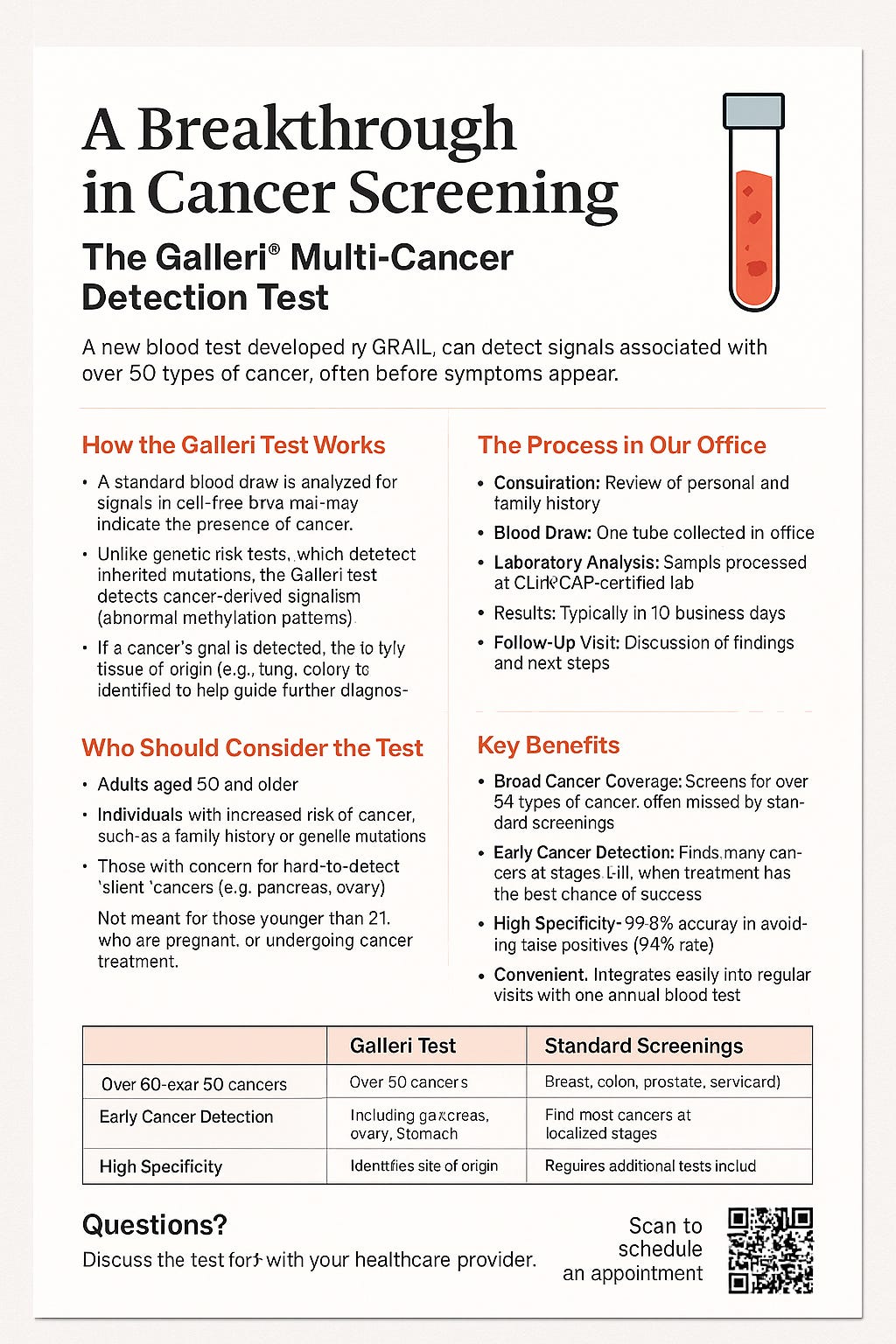
One of the most promising advances in recent years is the Galleri® multi-cancer early detection (MCED) test developed by GRAIL. This new blood test can detect signals from over 50 types of cancer—often before symptoms appear—and may help identify cancers that are traditionally difficult to find early, such as pancreatic, ovarian, and liver cancers.
What Is the Galleri Test?
The Galleri test is a simple blood draw that analyzes cell-free DNA circulating in your bloodstream for abnormal methylation patterns—tiny chemical markers that can indicate cancer activity.
It is designed to complement (not replace) standard screenings such as mammograms, colonoscopies, and PSA tests.
The test is generally recommended for:
Adults age 50 and older
Individuals at higher risk for cancer, such as those with a family history or significant environmental exposure
It is not intended for people under 21, pregnant individuals, or those currently in active cancer treatment.
How to Access the Test
Our practice is now offering the Galleri test as part of our preventive and longevity-focused care program.
To get started:
Schedule a short consultation with me or one of our clinicians.
If appropriate, we’ll order the test through our certified partner laboratory (CLIA-approved and CAP-accredited).
A simple blood draw will be done in our office.
Results are available in about 10 business days, followed by a personalized review and next steps.
Key Benefits
The Galleri test has demonstrated impressive results in large clinical studies such as PATHFINDER 2 (25,000 participants):
Early Detection: Found many cancers at Stage I–III, when treatment outcomes are best.
Wide Coverage: Screens for 50+ cancers, including those lacking standard screening tests.
High Specificity: 99.6% accuracy in avoiding false positives.
Cancer Site Prediction: Correctly identified the cancer’s tissue of origin in about 90% of cases.
Ease & Convenience: One annual blood test can complement your existing screenings.
Cost and Coverage
Price: $949 (currently discounted to $799 through October 2025 for self-pay patients).
Insurance: Most insurance plans do not yet cover the test since FDA approval is still pending, though it is available under laboratory-developed test regulations.
Payment Options: We can discuss flexible arrangements or alternative screening strategies based on your needs.
What to Keep in Mind
While the Galleri test is exciting, it’s important to understand its current limitations:
A “cancer signal detected” result is not a definitive diagnosis—it requires further imaging or biopsy.
A “no signal detected” result doesn’t guarantee absence of cancer; routine screenings remain essential.
Some cancers may not shed detectable DNA, and some very slow-growing cancers may be identified that never cause harm.
Additional large-scale trials (like the ongoing NHS-Galleri study in the UK, results expected in 2026) will help clarify how much the test can reduce cancer-related deaths.
The Future of Preventive Medicine
The Galleri test is part of a new generation of liquid biopsy technologies transforming healthcare.
In the next few years, we expect:
Wider adoption once long-term outcome data are published.
Integration with artificial intelligence to improve accuracy.
Expansion into personalized cancer monitoring and recurrence tracking.
Broader insurance coverage as costs decrease and validation grows.
These innovations signal a shift toward proactive, precision-based healthcare, allowing us to catch disease earlier—when it’s most treatable.
Common Questions
Q: How accurate is it?
In the PATHFINDER 2 study, Galleri achieved 73.7% sensitivity for the 12 deadliest cancers and 99.6% specificity overall.
Q: Who should consider it?
Adults 50+ or younger individuals with a strong family history or elevated risk factors. It’s meant to add to, not replace, standard screenings.
Q: What happens if the test detects a cancer signal?
We’ll immediately coordinate confirmatory diagnostics (scans, biopsies) and guide you through the next steps—often leading to earlier, more effective treatment.
Q: Is it covered by insurance?
Currently, most plans do not cover it. TRICARE is one exception for eligible beneficiaries.
Q: How does it fit into prevention overall?
When combined with lifestyle changes—nutritious diet, regular exercise, quality sleep, and smoking avoidance—it strengthens a comprehensive cancer-prevention strategy
Blessings.
Afshine Ash Emrani, M.D., F.A.C.C.
Assistant Clinical Professor, UCLA
David Geffen School of Medicine
Castle-Connolly Nationwide Top Doctor (Since 2008)
Los Angeles Magazine Super Doctor (Since 2010)
LA Style Magazine Top 100 Doctors in America (2024)
Subscribe to my newsletter: substack.com/@afshineemrani
Explore my books: Amazon Author Profile