

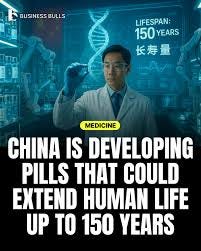
The recent claims from China regarding a drug that could extend human life to 150 years represent a fascinating intersection of biotechnology, national ambition, and the global quest to combat aging. While these developments are grounded in promising preclinical data, they must be viewed through the lens of evidence-based medicine. Below, I outline this topic point by point, drawing on current research, potential future impacts, parallel efforts worldwide, and an optimistic outlook for the near term.1. Understanding China’s Longevity Drug DevelopmentChina’s initiative stems from Lonvi Biosciences, a Shenzhen-based biotech startup, which has developed a compound called PCC1 derived from grape seed extract. This substance targets “senescent” or “zombie” cells—aging cells that accumulate and contribute to inflammation, tissue degradation, and age-related diseases like cancer, Alzheimer’s, and cardiovascular conditions. In mouse studies, PCC1 eliminated these cells, resulting in a lifespan extension of over 9%, improved physical strength, and reduced frailty.
The company claims this could translate to humans living up to 150 years by resetting cellular aging clocks and promoting youthful function in organs and tissues.From a medical standpoint, PCC1 functions as a senolytic agent, selectively inducing apoptosis (programmed cell death) in senescent cells while sparing healthy ones. Early human trials involved just 17 participants over three days, showing no adverse effects but limited efficacy data.
This is part of China’s broader national strategy, backed by billions in funding, to address its aging population crisis—where over 20% of citizens are now over 60—through “immortality islands,” longevity labs, and supplements like grapeseed pills.
However, experts caution that mouse-to-human translation is unreliable, and rigorous Phase II/III clinical trials are needed to validate safety and longevity benefits.2. What This Means for the Future of Human Health and SocietyIf validated, PCC1-like drugs could revolutionize preventive medicine by shifting focus from treating age-related diseases to preventing them at the cellular level. Imagine a world where chronic conditions like osteoporosis, diabetes, and neurodegeneration are delayed or mitigated, allowing people to remain productive and independent well into their second century. This could reduce healthcare burdens, with global savings in the trillions, as aging populations strain systems worldwide.Societally, extending life to 150 years raises profound questions: How would economies adapt to longer working lives? Retirement ages might rise to 100, fostering multi-career paths and intergenerational knowledge transfer. Ethically, access disparities could exacerbate inequalities—wealthy nations or individuals might benefit first, leading to a “longevity divide.” Environmentally, a larger, longer-living population could strain resources, necessitating sustainable innovations in food, energy, and urban planning.
Medically, we’d need to redefine “old age,” with new protocols for mental health, reproduction (e.g., fertility extension), and end-of-life care. Overall, this signals a paradigm shift toward “healthspan” over mere lifespan—living longer, but healthier.3. Who Else Is Working on Lifespan Extension?China is not alone; longevity research is a global endeavor with numerous players advancing similar technologies.
United States-Based Efforts: Companies like Calico (Alphabet-backed) focus on cellular aging mechanisms, while Unity Biotechnology develops senolytics targeting eye and lung diseases. Altos Labs, funded by Jeff Bezos and Yuri Milner, explores cellular reprogramming to reverse aging, inspired by Yamanaka factors.
labiotech.eu
Researchers like David Sinclair at Harvard study sirtuins and NAD+ boosters (e.g., NMN supplements) to activate longevity genes.
European and Global Initiatives: In the UK, the SENS Research Foundation, led by Aubrey de Grey, pursues “damage repair” strategies like removing amyloid plaques and cross-links in tissues. Swiss firm Rejuvenate Bio uses gene therapy to extend dog lifespans, with human applications in sight.
scispot.com
Israel’s Insilico Medicine employs AI for drug discovery, accelerating anti-aging compounds.
Other Asian Players: Japan’s Okinawa Institute of Science and Technology investigates centenarian genetics, while South Korea’s KAIST explores telomere extension. Collaborative projects, like the Longevity Biotechnology Association, unite these efforts.
Notable stocks in this space include Pacific Biosciences (genomics for aging research) and Voyager Therapeutics (gene delivery for neurodegenerative reversal).
Overall, over 100 biotechs worldwide are in this race, with investments topping $10 billion annually.
4. What Else Is Being Done for Longevity?Beyond drugs like PCC1, longevity research encompasses diverse approaches:
Gene Editing and Therapy: CRISPR-Cas9 is used to edit longevity genes (e.g., FOXO3 in Chinese monkey studies, reversing aging across 61 tissue types).
@commiepommie
Epigenetic reprogramming, as in Altos Labs’ work, “resets” cells to a youthful state.
Pharmacological Interventions: Metformin (a diabetes drug) is in TAME trials to delay aging onset. Rapamycin and its analogs suppress mTOR pathways to mimic caloric restriction benefits. Senolytics like dasatinib-quercetin combos clear zombie cells in human trials.
Lifestyle and Tech Integrations: AI-driven platforms (e.g., from Insilico) predict aging biomarkers, while wearables track real-time health metrics. Regenerative medicine, including stem cell therapies and organoids, repairs age-damaged tissues. Nutritional advances, like personalized diets based on gut microbiomes, enhance resilience.
Public and Private Funding: Governments (e.g., U.S. NIH’s $200M+ in aging grants) and philanthropists (e.g., Hevolution Foundation’s $1B pledge) fuel progress. Clinical trials for over 20 anti-aging drugs are underway globally.
ff.co +1
5. An Optimistic View for the Next 3-5 YearsLooking ahead to 2028-2030, the trajectory is profoundly encouraging. With accelerating AI in drug discovery—cutting development time from decades to years—we could see FDA approvals for first-generation senolytics and NAD+ therapies by 2028, potentially adding 5-10 healthy years to average lifespans.
China’s PCC1 might enter Phase III trials, providing real-world data on human efficacy, while global collaborations (e.g., via WHO aging initiatives) democratize access.Breakthroughs in multi-omics (genomics + proteomics) will enable personalized longevity plans, preventing diseases before symptoms arise. Expect widespread adoption of at-home biomarkers tests, similar to today’s blood sugar monitors, empowering individuals to optimize health. Economically, the $85B anti-aging market could double, creating jobs in biotech and elder care innovation.
Societally, longer lives could foster wisdom-driven policies, reducing conflicts and enhancing sustainability.In summary, while 150 years remains aspirational, the science is advancing rapidly. As a physician, I envision a future where aging is not inevitable decline but a manageable phase, unlocking human potential like never before. Continued ethical oversight and equitable distribution will be key to realizing this promise.
Blessings.
Afshine Ash Emrani, M.D., F.A.C.C.
Assistant Clinical Professor, UCLA
David Geffen School of Medicine
Castle-Connolly Nationwide Top Doctor (Since 2008)
Los Angeles Magazine Super Doctor (Since 2010)
LA Style Magazine Top 100 Doctors in America (2024)
Subscribe to my newsletter: substack.com/@afshineemrani
Explore my books: Amazon Author Profile
Just an aside - I thought that recently things like seed oil was considered a negative because of inflammation. Grapeseed sounds like a seed oil. Why would it be considered bad but this derived medicine be considered good?