


I see this man every month. The name and the chart number change. The story does not. Mid-fifties. Second heart attack. He lost the weight, then gained it back. His A1C is creeping up again. His liver is scarring on ultrasound. His knees are finished. He looks at me from the hospital bed and says the line I have heard a thousand times.
I’m trying.
He is. The problem was never effort. The problem is that obesity, type 2 diabetes, and fatty liver are diseases — biological riptides — running in an environment engineered to drown us. Telling people to swim harder is not a strategy. It is malpractice dressed up as virtue.
Which brings me to retatrutide.
I have been tracking this drug for nine months. I am not a stock pumper, I do not sell gray-market vials, and I have no financial relationship with Eli Lilly. I am writing this as a cardiologist who treats the wreckage of metabolic disease for a living: heart attacks, heart failure, strokes, kidneys giving out, livers turning to scar. If the Phase 3 program now reading out continues to deliver what the early data has shown, retatrutide will not be another weight-loss drug. It could be the most consequential medicine of our lifetime, and quite possibly the best-selling drug ever made. Not because the world wants smaller jeans. Because almost everyone alive today is somewhere on the metabolic-disease spectrum, and for the first time we have a tool that hits the disease at its root.
Let me show you why.
Buy my new book: BEYOND THE WHITE COAT
A quick map of how we got here
Think of your body’s energy balance as a seesaw. One side is what you eat. The other is what you burn.
First generation — semaglutide (Ozempic, Wegovy). One lever: the GLP-1 receptor. It slows digestion, quiets the food noise in your brain, and helps your pancreas time insulin to meals. Brilliant at cutting calories in. Does almost nothing to raise calories out.
Second generation — tirzepatide (Mounjaro, Zepbound). Two levers: GLP-1 plus GIP. Stronger appetite control, better glucose handling. Already on track to gross around $45 billion this year — more than most blockbusters in history combined.
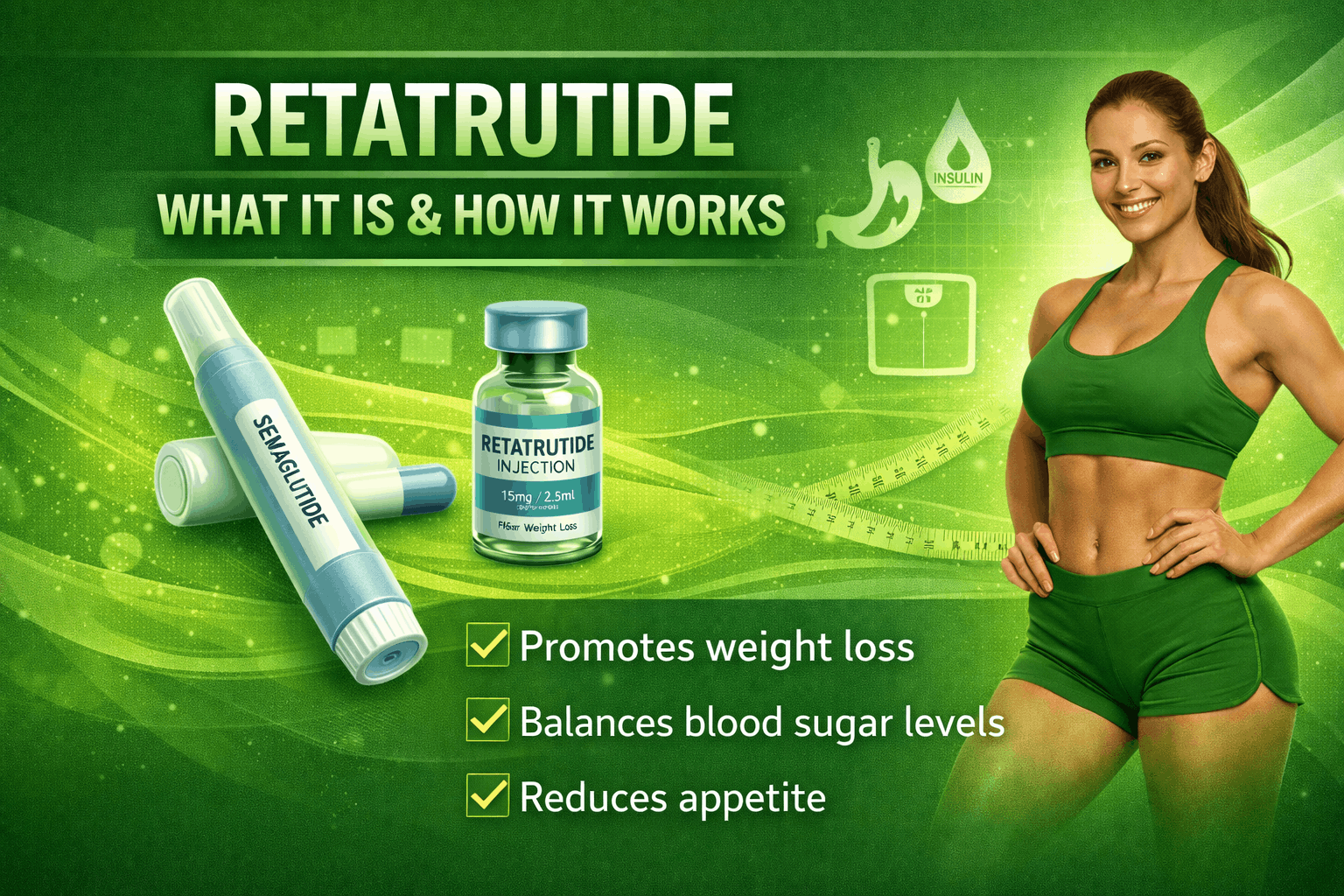
Third generation — retatrutide. Three levers: GLP-1, GIP, and glucagon. The glucagon piece is what changes the math. Glucagon receptors live mostly in the liver. Activate them in the precise, balanced way retatrutide does, and the liver starts oxidizing stored fat for fuel — even when you are sitting at a desk, sleeping, or walking the dog. Meanwhile the GLP-1 and GIP arms keep blood sugar tight, so glucagon does not push glucose the wrong way. Calories in fall. Calories out rise. Both sides of the seesaw, simultaneously.
It is the difference between a two-wheel-drive truck and a three-engine off-road rig. And the early numbers reflect it.
What the data is saying
The Phase 2 paper in the New England Journal of Medicine showed an average 24.2 percent reduction in body weight at 48 weeks on the 12 mg dose — and the curve was still falling at the end of the trial, not flattening. That alone was unprecedented. Then came the readouts now stacking up in 2026:
In type 2 diabetes (TRANSCEND-T2D-1, March 2026), A1C dropped by up to 2.0 percent and patients on 12 mg lost an average of 36.6 pounds — 16.8 percent of body weight — at only 40 weeks. The weight curve had not plateaued.
In obesity with knee osteoarthritis (TRIUMPH-4, December 2025), 12 mg patients lost an average of 28.7 percent of body weight at 68 weeks — about 71 pounds — with substantial reductions in pain and improvements in physical function.
In a Phase 2 substudy of fatty liver disease, an 86 percent reduction in liver fat. Ninety-three percent of treated patients normalized their livers. Seventy-two percent of prediabetics returned to normal blood sugar.
That last bullet is the one that should make every primary care doctor put down their coffee. Roughly 40 percent of adults globally now have fatty liver. Lifestyle alone almost never reverses it fast enough to outrun the cirrhosis clock. This drug appears to do it.
As the cardiologist in the room, here is my favorite part. Obesity, fatty liver, and insulin resistance are the engines of cardiovascular disease. Lower them at the source and you start preventing the events that fill my cath lab. The dedicated cardiovascular outcomes trials are still running, but blood pressure, lipid panels, and inflammatory markers are already moving in the right direction. We will know more soon. The mechanism makes sense.
What it actually feels like
I have microdosed retatrutide myself — not for dramatic weight loss, but to study the experience and to feel what my patients describe.
The thing nobody warned me about was how loud my own internal food chatter had been until it stopped. The constant low-grade negotiation with snacks, drinks, the pantry at 9 p.m. — gone. Quiet. The willpower I used to spend swatting cravings was suddenly free for work, family, and thought. It is the first drug I have taken that gave me back a piece of my own attention.
Patients describe the same thing. Less pull toward alcohol. Fewer mindless scrolls. Weaker grip from gambling, shopping, compulsive eating. The dopamine system and the metabolic system are deeply wired together, and these drugs are showing us the seam.
The honest caveats
The side effects are real. Mostly gastrointestinal in the first months — nausea, constipation, diarrhea — and slow titration helps most patients through it. In TRIUMPH-4, discontinuation rates due to adverse events ran at 12.2 percent on the 9 mg dose and 18.2 percent on the 12 mg dose, versus 4 percent on placebo. In the diabetes trial, where the population was healthier and the doses titrated differently, discontinuation rates were dramatically lower (2.2 to 5.1 percent).
A new wrinkle from TRIUMPH-4: a small but real signal of dysesthesia — abnormal skin sensations — in roughly 2 to 5 percent of treated patients. Most cases were mild and resolved during treatment, but it is the kind of thing serious clinicians track carefully. We do not yet know what is driving it. Long-term safety beyond 68 weeks is still being characterized, which is exactly why we wait for Phase 3 to finish before declaring victory.
Retatrutide is also not yet approved. Eli Lilly has seven more Phase 3 readouts expected in 2026 across obesity, diabetes, sleep apnea, low back pain, fatty liver, and cardiovascular outcomes. The FDA has rightly cracked down on gray-market and compounded versions, because injectables made without quality control are genuinely dangerous. Do not buy from random websites. Do not chase a peptide on Telegram. The molecule in the vial is the entire ballgame.
Until approval, tirzepatide and semaglutide remain the evidence-based options for patients who qualify. They are excellent drugs. For most patients, they will be the right answer for the next year or two regardless. The question is what comes next, and the data is telling us that something larger is.
The moral objection, and why it is wrong
Every breakthrough gets the same sermon. This is cheating. People should just eat less and move more. I heard it about statins. I heard it about blood pressure medication. I heard it about insulin.
Obesity, type 2 diabetes, and fatty liver are diseases, not character flaws. They hijack human biology in an environment designed to maximize calories and minimize movement. Demanding that patients earn their health through suffering, while their arteries calcify and their livers scar, is not compassion. It is cruelty wearing a virtuous costume.
Retatrutide does not replace lifestyle. It makes lifestyle possible. Patients finally get the cognitive headroom to lift, walk, sleep, and eat real food without fighting their own brain stem at every meal. Every clinician I trust who has watched this class of drug in practice has come to the same conclusion: we are not lowering the bar. We are removing a thumb that was on the scale.
Why I think it becomes the biggest drug in history
Tirzepatide is already heading toward tens of billions in annual sales. Retatrutide, if it lands at the 24 to 28 percent weight-loss range with the metabolic add-ons we are seeing, plausibly eclipses it. The global iPhone franchise grosses around $230 billion a year. Metabolic disease touches more people than any phone ever has. The peptide era is in its first chapter.
I do not say this lightly. I have spent more nights than I can count talking to families in the cardiac ICU about a death that did not have to happen — a heart attack, a stroke, a heart failure decompensation in a patient whose underlying disease was metabolic and treatable in principle and untreated in practice. If retatrutide delivers on its current promise, it will not just shrink waistlines. It will shrink heart-failure wards. It will shrink diabetes clinics. It will shrink liver-transplant lists. It will shrink the part of my job I most wish did not exist.
That is what is at stake. Not vanity. Not a celebrity drug. The structural disease of modern life, met for the first time by a tool roughly the size of the problem.
Talk to your doctor. Be patient through approval. Stay off the gray market. And pay attention. The next twelve months are going to be one of the most consequential stretches in the history of internal medicine, and most people are still treating it like a diet fad.
It is not a diet fad. It is a turning point.
What do you think — ready for the triple-threat era, or still skeptical? Drop your questions below. I read every comment.
buy my new book BEYOND THE WHITE COAT
Afshine Ash Emrani, M.D., F.A.C.C.
Assistant Clinical Professor, UCLA
David Geffen School of Medicine
Castle-Connolly Nationwide Top Doctor (Since 2008)
Los Angeles Magazine Super Doctor (Since 2010)
LA Style Magazine Top 100 Doctors in America (2024)
This is not medical advice. Retatrutide is not FDA-approved as of this writing. Always consult your physician before starting or stopping any medication. The views above are my own, based on publicly available data through April 2026.
With respect to your book, do you have any signed copies for sale?
Sounds like shilling for pharma. Especially if needy people are on it for life. Nobody is ever “cured” just maintained at great cost either way. Pick your poison I guess.