

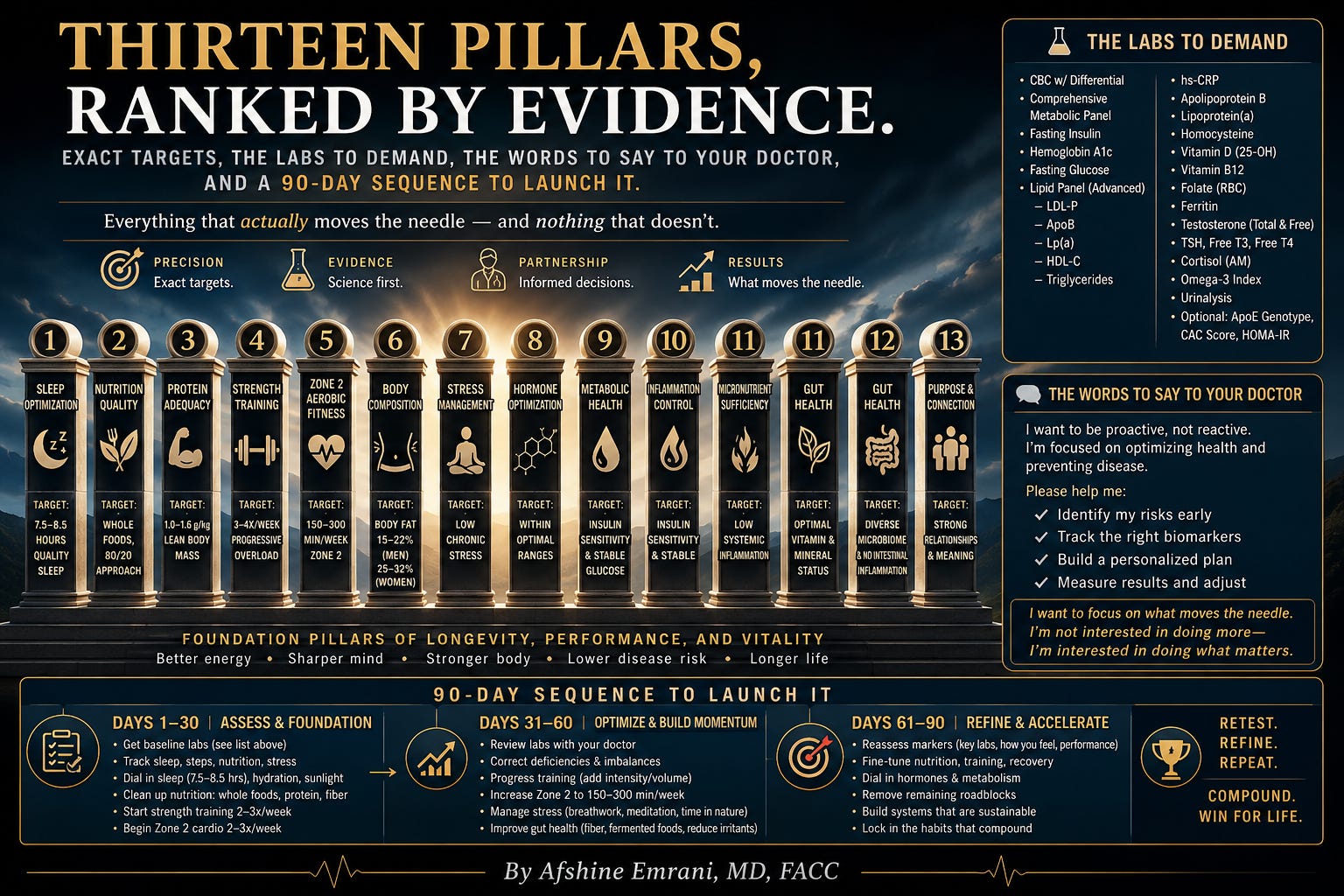
Thirteen pillars, ranked by evidence. Exact targets, the labs to demand, the words to say to your doctor, and a 90-day sequence to launch it. Everything that actually moves the needle — and nothing that doesn’t.
By Afshine Emrani, MD, FACC
I have spent more than two decades as a cardiologist, and I want to tell you what I have learned about longevity by watching thousands of people either age well or fall apart.
The people who transform are almost never the ones with the most exotic protocol.
They are not the ones taking forty supplements. They are not the ones with the cold plunge and the hyperbaric chamber and the $2 million annual spend. I have watched people do all of that and still die on schedule, because they optimized the periphery and ignored the center.
The people who transform are the ones who executed a boring hierarchy relentlessly, measured whether it was working, and adjusted.
That is the entire secret, and it is unsatisfying, and it is true.
So this is that hierarchy. Thirteen pillars, ordered roughly by the strength of evidence and the size of the effect. For each one: why it matters, exactly how to implement it, what to measure, the specific words to say to your physician, and the ways people most commonly fail.
This is not theory and it is not a wish list. It is the distilled operating system I use for myself and recommend to my own patients and my own family.
Print it. Bring the relevant sections to your appointments. Then execute.
PILLAR 1: Sleep Like It Is the Most Important Drug You Take
Why it matters
Sleep is the single most underrated intervention in all of medicine, and the reason is that its benefits are invisible while its absence is catastrophic.
During deep sleep your brain runs a cleaning cycle — the glymphatic system physically clears toxic proteins including the amyloid implicated in Alzheimer’s disease. Your body performs cellular repair. Testosterone and growth hormone are produced. Blood pressure dips. Inflammation resolves. Memory consolidates.
Skimp on it, and none of that happens properly.
And here is the finding that reframed my thinking: in an analysis of 60,977 adults tracked with accelerometers, sleep regularity predicted mortality better than sleep duration. The most consistent sleepers had 20-48% lower all-cause mortality than the most chaotic — with reductions in cancer and cardiometabolic mortality as well.
A steady 6.5 hours may genuinely beat a chaotic 8.
How to implement
Fix your bed and wake times within ±30 minutes, seven days a week. Including weekends. This is where nearly everyone fails, and it is the highest-leverage item on this entire list. Sleeping in on Saturday inflicts what amounts to social jet lag on your circadian system.
Target 7-9 hours of actual sleep — most adults need 7.5-8.5.
Bedroom conditions: 63-67°F, blackout dark, no LED indicators. Cool and dark are not preferences; they are physiological requirements for deep sleep.
Last caffeine before noon. Caffeine’s half-life is roughly 5-6 hours, and longer in slow metabolizers. That 4pm coffee is still measurably present at midnight.
Last meal three hours before bed. Late eating disrupts sleep architecture and blunts the overnight repair window.
Wind-down: dim the lights and stop screens 60 minutes before bed, or use blue-blocking glasses and read something on paper.
The test almost nobody gets
If you snore, wake unrefreshed, or your partner notices you stop breathing — get a home sleep apnea test.
Untreated sleep apnea drives hypertension, atrial fibrillation, insulin resistance, systemic inflammation, and low testosterone. It is enormously underdiagnosed. And treating it can improve nearly every other number in this article.
What to say to your doctor
“I’d like to rule out sleep apnea with a home sleep study, and review whether any of my medications may be disrupting my sleep.”
How people fail
They chase a perfect sleep score on a wearable and develop orthosomnia — anxiety about sleep that itself destroys sleep. Track regularity, not perfection. If the data is making you anxious, stop looking at it.
PILLAR 2: Train for VO2 Max and Strength
Why it matters
Cardiorespiratory fitness is arguably the strongest predictor of all-cause mortality we have ever measured.
In a Cleveland Clinic study of over 122,000 adults, the least fit had four to five times the death risk of the fittest — and there was no upper limit of benefit. Fitter was always better, at every level examined.
To put it in the terms my patients understand: being in the bottom quartile of fitness for your age carries a mortality risk comparable to being a smoker.
And muscle is not merely for movement. It is your largest glucose disposal organ, a major endocrine tissue, and the single best protection against the frailty that ends independence.
How to implement
Zone 2 cardio: 150-300 minutes per week. Conversational pace — you can talk but not sing. Roughly 60-70% of maximum heart rate. Walking briskly uphill counts. This builds mitochondrial density and the aerobic base everything else sits on.
Resistance training: 2-4 sessions per week. Prioritize compound movements that load the whole system — squat, hinge (deadlift), push, pull, and carry. Progressive overload is the entire point. If the weight never increases, the stimulus never increases.
After every meal: a 10-15 minute walk. This blunts post-meal glucose excursions more effectively than almost any free intervention available.
Once or twice a year, measure VO2 max — a lab test, a wearable estimate, or a Cooper test.
Targets
Men over 40: VO2 max above 40 ml/kg/min
Women over 40: above 35 ml/kg/min
Grip strength and leg strength improving year over year
What to say to your doctor
“I’d like a baseline fitness assessment or VO2 max estimate, and clearance to begin progressive resistance training.”
How people fail
They do only cardio and lose muscle every year. Or they lift the same weights for a decade and wonder why nothing changes. The biggest single win available to most people is simply climbing out of the bottom fitness quartile — that transition carries more benefit than anything else in this article.
PILLAR 3: Eat the Mediterranean Pattern With Smart Protein
Why it matters
The Mediterranean dietary pattern has the strongest and most consistent evidence base for cardiovascular and longevity outcomes of any way of eating we have studied.
And there is a nuance most people are getting wrong right now: excess protein — particularly animal-sourced protein in midlife — chronically activates mTOR, the cellular growth pathway. A major 2026 review synthesizing over 350 studies found that protein restriction, while still meeting needs, consistently improved metabolic health and extended lifespan across species. The traditional Okinawan diet ran roughly 9% of calories from protein.
The nuance that matters: exercise appears to protect against this. Athletes consuming large amounts of protein do not develop the metabolic consequences, likely because the protein goes into building muscle rather than idling in growth pathways. Protein without exercise is the problem — not protein.
How to implement
Base every meal on: olive oil, vegetables, legumes, nuts, whole grains, and fatty fish 2-3 times weekly.
Protein: moderate, individualized. Roughly 1.0-1.6 g/kg depending on activity level and age. Shift toward plant and fish sources before 65. After 65, protect muscle more aggressively — sarcopenia becomes the larger threat, and older adults need more protein, not less.
Front-load your calories. Insulin sensitivity peaks in the morning and declines through the day. The identical meal produces meaningfully different metabolic consequences at 8am versus 8pm. Bigger breakfast and lunch, lighter dinner. Stop eating three hours before bed.
Fiber: 25-38 grams daily. It lowers LDL, feeds the microbiome, and stabilizes glucose. Most of my patients get half that.
Cut hard: added sugar, ultra-processed food, industrial seed oils, excess alcohol.
Track
Triglyceride-to-HDL ratio under 2 — ideally under 1. You can calculate it from any standard lipid panel for free, and it is one of the best available proxies for insulin resistance.
How people fail
They pursue dietary perfection, sustain it for six weeks, then abandon it entirely. You do not need perfection. You need consistency that compounds across decades.
PILLAR 4: Fix the Two Cheapest Deficiencies
Why it matters
Magnesium and vitamin D deficiencies are epidemic, inexpensive to correct, and quietly drive poor sleep, elevated inflammation, higher blood pressure, worse mood, and impaired muscle function.
Up to 75% of adults are low in magnesium. Most have no idea.
How to implement
Magnesium glycinate: 300-400mg elemental, at night. Magnesium calms blood vessels, supports normal heart rhythm, deepens sleep, and participates in over 300 enzymatic reactions. The glycinate form is highly absorbable and gentle on the stomach.
In my experience, patients notice the difference in sleep quality and baseline calm within one to two weeks — more than with almost any other single change on this list.
Vitamin D3 with K2: dose to achieve a blood level of 50-80 ng/mL — not the bare minimum of 30 that most labs accept as normal. This typically requires 2,000-5,000 IU of D3 with 100-200 mcg of K2. Take it in the morning with a meal containing fat, since it is fat-soluble.
Why these two work as a system: magnesium is required to convert vitamin D into its active form, so taking D without adequate magnesium can worsen a magnesium deficit. And K2 helps direct absorbed calcium toward bone rather than soft tissue.
An honest note on K2: the trial data on K2 and vascular calcification is genuinely mixed — one trial found no significant effect, a more recent one found roughly 29% less calcium progression. Nobody has shown K2 reduces heart attacks or deaths. The defensible rationale is calcium partitioning, not proven plaque reversal. And if you take warfarin, K2 is off the table without your physician — it directly antagonizes the drug.
Retest vitamin D every 3-6 months until stable.
What to say to your doctor
“Please check my 25-OH vitamin D. I want to optimize to 50-80 ng/mL, not simply clear the threshold of 30.”
PILLAR 5: Add GlyNAC If You Are Over 55 or Inflamed
Why it matters
Glutathione is your body’s master antioxidant. It protects mitochondria, recycles other antioxidants, and defends cells against oxidative damage. And it collapses with age — older adults are reliably deficient.
When glutathione drops, mitochondria slow, inflammation rises, insulin resistance worsens, and recovery fails.
Here is the elegant part: glutathione production has two bottlenecks, not one. Both glycine and cysteine run short with age. Supply only one and you do not fix the gap. Supply both — glycine plus N-acetylcysteine, together called GlyNAC — and the factory restarts.
In randomized trials at Baylor College of Medicine, older adults taking GlyNAC for 16 weeks improved nearly every hallmark of aging simultaneously: mitochondrial function, oxidative stress, inflammation, insulin resistance, endothelial function, strength, cognition, and gait speed. Some markers returned toward young-adult range. In aged mice, the combination extended lifespan by roughly 24%.
How to implement
Trial dose: approximately 100 mg/kg body weight daily of each compound, split into 2-3 doses. For a 70kg adult, roughly 7g glycine and 7g NAC daily.
Start lower and titrate up. Take with food if you experience GI upset.
This is maintenance, not a cure. Benefits faded within about 12 weeks of stopping in the trials. Treat it like brushing your teeth.
The honest caveats
The trials were small — dozens of participants, not thousands. The strongest effects were in older adults with documented glutathione deficiency; a young, healthy person with normal glutathione will likely see much less. The lifespan data is in mice.
Discuss with your physician first if you have kidney disease, or take nitrates or blood thinners.
What to say to your doctor
“I’d like to discuss GlyNAC based on the Baylor trials. Can we check inflammatory markers first and monitor while I’m on it?”
PILLAR 6: Measure the Fire, Not the Smoke
Why it matters
Your standard annual panel was designed to detect disease that has already arrived. The markers below detect the disease that is coming — often a decade earlier.
The labs to demand
Fasting insulin — target under 5 μIU/mL (ideally 3-4). This is the ten-year warning bell, and almost nobody checks it. Your glucose and HbA1c can look perfectly normal for a decade while your pancreas works progressively harder to keep them there. By the time A1c rises, substantial damage has accumulated.
HOMA-IR — under 1.0. Calculated from fasting insulin and glucose. The best single measure of insulin sensitivity.
ApoB — under 80 mg/dL at moderate risk, under 60 at high risk. Every atherogenic particle carries exactly one ApoB molecule, making this a direct count of the particles that can damage your artery wall. One analysis found 54% of patients had dangerous ApoB levels that standard LDL testing missed entirely.
Lp(a) — once in your lifetime. Genetically determined, essentially unchangeable, and about 1 in 5 people carry elevated levels that triple heart attack risk. Diet and exercise do not touch it. Most people have never been tested. If yours is high, tell your first-degree relatives — it is inherited.
hs-CRP — under 1.0 mg/L. Inflammation. You can have flawless cholesterol and arteries actively preparing to rupture. (Note: it rises with any acute infection — never interpret a single value while you’re ill.)
HbA1c — under 5.4%, not merely under the 5.7% prediabetes threshold.
Triglyceride:HDL ratio — under 2, ideally under 1.
Home blood pressure — under 130/80. Buy a cuff. Measure morning and evening, seated quietly five minutes, arm at heart level. Office readings mislead in both directions.
Also worth having: homocysteine, full thyroid panel, ferritin and iron studies, urine albumin-to-creatinine ratio, and uric acid.
Frequency
Baseline, then every 6-12 months while actively optimizing.
What to say to your doctor
“I’d like an advanced preventive panel including fasting insulin, ApoB, hs-CRP, and Lp(a). Here’s the list.”
If your physician declines, you’re entitled to ask why — or to find one who understands that “within the reference range” and “optimal” are not the same thing.
PILLAR 7: Quiet the Chronic Inflammation
Why it matters
Inflammation is what destabilizes plaque and causes it to rupture — even when cholesterol looks perfect. The JUPITER trial demonstrated that identifying and treating inflammation reduced cardiovascular events in people whose lipids appeared acceptable.
Chronic low-grade inflammation — “inflammaging” — is a shared root of heart disease, Alzheimer’s, cancer, and metabolic collapse. It is the fire under all of it.
How to implement
Lifestyle first, and it does most of the work: sleep, exercise, dietary pattern, visceral fat reduction, stress management, gut health.
And oral health. This is the one nobody mentions. Periodontal bacteria have been identified inside coronary plaque, and gum disease is associated with meaningfully higher cardiovascular risk. If your hs-CRP is stubbornly elevated and nobody can find why, go see your dentist. It may be the cheapest anti-inflammatory intervention in medicine.
If hs-CRP remains elevated with cardiovascular risk: discuss low-dose colchicine (0.5mg daily) with your physician. It reduced cardiovascular events in the LoDoCo2 and COLCOT trials and is now FDA-cleared for cardiovascular risk. It is dramatically underused.
On the horizon: IL-6 inhibitors are in late-stage trials for cardiovascular inflammation.
Monitor
hs-CRP every 3-6 months until consistently under 1.0.
Inflammation always has an address. Find it: gums, gut, visceral fat, sleep apnea, insulin resistance, alcohol, autoimmune disease, chronic stress.
PILLAR 8: Protect the Endothelium
Why it matters
The endothelium is the single-cell lining of every artery you own. It is not passive plumbing — it is a chemically active organ that regulates blood pressure, controls clotting, and governs what crosses into the artery wall.
Endothelial dysfunction is the first step in atherosclerosis. It precedes visible plaque by years. If you can protect it, you are intervening earlier than any imaging test can detect.
How to implement
Discuss daily low-dose tadalafil (2.5-5mg) with your physician. I take it myself, and not for the reason most people assume.
PDE5 inhibitors raise cGMP, which enhances nitric oxide signaling — the master pathway of vascular health. The data associates them with improved flow-mediated dilation, reduced arterial stiffness, and in observational cardiac cohorts, lower mortality. Sildenafil was originally developed for angina; we renamed the drug after its side effect and forgot what it was built for.
Daily low-dose tadalafil also treats BPH, so many men over 50 address two problems with one inexpensive generic pill.
Absolute safety rule: never combine with nitrates. Nitroglycerin, isosorbide, or recreational poppers. The combination can cause fatal hypotension. With tadalafil’s long half-life, that window extends 48 hours.
And a critical insight for men: new erectile dysfunction after 40 is often the earliest sign of vascular disease, because penile arteries are small and clog before the larger coronaries. It can precede a cardiac event by 3-5 years. Treating the ED without evaluating the heart is silencing the alarm and ignoring the fire.
If your ApoB is not at goal: ask about the newly FDA-approved oral PCSK9 inhibitor — a once-daily pill delivering roughly 60% LDL reduction, matching the injectable class, with reductions in ApoB and Lp(a) as well. For patients who refused injections for years, the barrier just fell.
What to say to your doctor
“Based on the endothelial data, can we discuss low-dose daily tadalafil? And is the oral PCSK9 inhibitor appropriate for me?”
PILLAR 9: Track Biological Age, Not Calendar Age
Why it matters
Your organs do not age at the same rate. Organ-specific clocks reveal which system is failing fastest — and that is where your effort belongs.
A 2026 WashU study published in Nature Medicine, analyzing over 164,000 people, found that those born in the 1990s show a biological age gap 92% larger than those born in the 1960s. Same chronological age, dramatically older biology. And the fastest agers had up to 15% higher risk of developing cancer before 55 — even after accounting for genetics.
The organ-specific findings were striking: an immune system that tested biologically older correlated with early lung cancer; fat tissue that tested older correlated with early colorectal cancer. The organs aging fastest are the ones producing disease first.
How to implement
Start free. PhenoAge is calculated from nine standard markers you may already have: albumin, creatinine, glucose, CRP, lymphocyte percentage, mean corpuscular volume, red cell distribution width, alkaline phosphatase, and white blood cell count. That is a basic metabolic panel plus a CBC plus CRP. Free online calculators exist — enter your numbers and your actual age.
Then, if you want deeper insight: epigenetic clocks such as Horvath, GrimAge, and DunedinPACE analyze DNA methylation patterns from blood or saliva. Roughly $200-500, results in weeks.
Re-measure after major lifestyle or therapeutic changes. Every marker in PhenoAge responds to the interventions in this article — CRP falls with exercise and anti-inflammatory eating, glucose improves with dietary change, immune markers normalize with better metabolic health and reduced stress.
Your birth year is fixed. Your biological age is not.
PILLAR 10: Keep the Immune System Young
Why it matters
Immune aging — immunosenescence — and the accumulation of senescent “zombie” cells drive the systemic inflammation underneath nearly every chronic disease of aging. Senescent cells stop dividing but refuse to die, secreting a stream of inflammatory signals that damages surrounding tissue.
How to implement, honestly
Pillars 1-9 are your senolytic protocol. I want to be direct about this, because the supplement industry is currently selling senolytics with almost no human outcome data.
Exercise, quality sleep, metabolic health, and maintained muscle mass are the strongest evidence-based defenses against immune aging that currently exist. Muscle is an immune organ, not merely a movement organ.
Also: avoid chronic infections, stay current on vaccines, treat gum disease and gut inflammation, and manage chronic stress, which measurably ages the immune system.
Watch this space carefully. Senolytics, thymus rejuvenation, and CAR-Treg cell therapies are advancing rapidly, and the science is genuinely exciting. But discuss emerging options only under physician supervision and only as human data matures. Do not experiment on yourself with compounds that have no trials behind them.
PILLAR 11: Hormones — The Pillar Most Longevity Protocols Skip
Why it matters
Nearly every longevity protocol I read omits hormones entirely. In my exam room, it is the subject people are most desperate to raise and least able to say out loud.
It is not vanity medicine. It is vascular, metabolic, skeletal, and cognitive medicine.
For men
Get the right labs, drawn in the morning when levels peak: total and free testosterone, plus estradiol, prolactin, and LH. Prolactin matters because an elevation can occasionally signal a pituitary issue that is treatable and important not to miss.
Chase the upstream causes first. Sleep apnea, visceral obesity, high blood sugar, and heavy alcohol all suppress testosterone. Fix those and the numbers frequently climb without any prescription.
When testosterone is genuinely low with symptoms: replacement restores drive, energy, mood, and muscle mass. The TRAVERSE trial provided reassuring cardiovascular safety data and the FDA subsequently removed the old black-box warning.
But it requires real monitoring — hematocrit (testosterone thickens blood, which matters enormously to a cardiologist), PSA, and estradiol. And if you want children, know that TRT can impair fertility; that conversation happens first.
Do not buy testosterone from a website or a pop-up clinic that hands it out without proper testing.
For women
This is where medicine has failed most spectacularly, and it is now being corrected.
In November 2025, the FDA began removing the black box warnings from hormone therapy, including vaginal estrogen. The FDA Commissioner described the original decision as one of the greatest errors in modern medicine. Roughly 50 million women were frightened away from treatment based on a misreading of the Women’s Health Initiative — in whose estrogen-only arm breast cancer risk was actually lower.
If sex has become painful, that is a diagnosis, not aging. It is called genitourinary syndrome of menopause, and local vaginal estrogen reverses it within weeks while barely entering the bloodstream. Major societies consider it highly safe — even for many breast cancer survivors, in consultation with their oncologist.
If you are on estrogen and progesterone makes you miserable — bloated, foggy, unwell — you have at least six alternatives: micronized rather than synthetic progesterone, vaginal rather than oral delivery, cyclic rather than continuous dosing, bedtime timing to harness its sedating effect, a levonorgestrel IUD, or an estrogen-SERM combination that requires no progestogen at all. Most women are only ever offered one regimen.
And if desire is gone despite loving your partner: low free testosterone is usually why. Women make testosterone too, and it plummets in midlife. Low-dose therapy — roughly a tenth of a male dose — improves desire, arousal, and orgasm in randomized trials. There is no FDA-approved female formulation in the US yet, so experienced clinicians prescribe off-label. It is the single most overlooked element of this entire conversation.
Also now available: flibanserin, FDA-approved in December 2025 for postmenopausal women with low desire; bremelanotide as an on-demand option; and fezolinetant, a non-hormonal pill that shuts off hot flashes at the brain’s thermostat.
The longevity connection
Physical intimacy raises oxytocin, lowers cortisol, improves sleep, and reinforces the single strongest predictor of how long you will live: the strength of your closest relationships. Loneliness carries mortality risk comparable to smoking.
Connection is medicine. It belongs in the protocol.
What to say to your doctor
Men: “I’d like morning total and free testosterone, plus estradiol, prolactin, and LH — and I want to rule out sleep apnea first.”
Women: “I’d like to discuss vaginal estrogen, systemic hormone therapy, and low-dose testosterone. I know the FDA has revised the warnings.”
Bring the specific words. Most clinicians will not raise these unless you do.
PILLAR 12: Protect the Skeleton
Why it matters
A woman’s lifetime risk of breaking a hip exceeds her combined risk of breast, uterine, and ovarian cancer. We screen relentlessly for the cancers and largely ignore the fracture — and the fracture is what takes her independence.
Roughly 1 in 4 people die within a year of a hip fracture. Many who survive never walk unassisted again, and a substantial portion never return home.
Men are not exempt. Men account for roughly 1 in 4 osteoporotic fractures, and when a man breaks a hip he is more likely to die from it than a woman is. Yet most men who suffer a fragility fracture are never evaluated for osteoporosis afterward.
Peak bone mass arrives in the mid-twenties. After that the trajectory declines, accelerating sharply through menopause. Most women are not scanned until 65 — by which point decades of opportunity are gone.
The good news: bone responds at any age
The LIFTMOR trial demonstrated it. Postmenopausal women with low bone mass performed 30 minutes of supervised high-intensity resistance and impact training, twice weekly, for eight months. Spine bone density rose 2.9% in the training group versus a 1.2% decline in controls — opposite directions in under a year.
How to implement
Bone responds to exactly two signals:
Heavy loading — weights genuinely challenging in the final reps. Impact — jumping, hopping, heel drops.
Walking, swimming, cycling, and yoga are excellent for other reasons. They will not build density the way heavy progressive resistance and impact will. Most women over 50 have been told to walk more and take calcium — advice that is not wrong, but is badly insufficient.
The protocol:
Strength train 2-4x weekly with compound movements loading hips and spine — squats, deadlifts, hip thrusts, overhead press, rows
Jump: 10-20 daily hops, skips, or rope (unless your joints or physician say otherwise)
Protein at every meal — bone is roughly half protein by volume
Calcium 1,000-1,200mg daily, food first, spread through the day
Vitamin D optimized (Pillar 4) — calcium is nearly useless without it
Train balance daily — single-leg stands and progressive work. Falls cause the fractures. This is the most underrated item here and it costs nothing.
Move all day; prolonged sitting signals bone to resorb
Get a DEXA earlier than 65 if you have risk factors: early menopause, family history, prior fragility fracture, steroid use, low body weight, malabsorption, or — for men — low testosterone, androgen deprivation therapy, or age over 70.
When lifestyle is not enough
For established osteoporosis, recent fragility fracture, T-score at or below −3.0, or multiple risk factors, escalate without apology: denosumab (potent anti-resorptive, every six months — never stop abruptly without transitioning), teriparatide (anabolic, builds new bone, typically limited to two years then followed by an anti-resorptive), or romosozumab (dual action, note the cardiovascular boxed warning).
Sequence matters: in very high-risk patients, starting with an anabolic and then following with an anti-resorptive produces larger gains than the reverse.
PILLAR 13: Catch Disease Before It Announces Itself
Why it matters
Every pillar above is about changing your trajectory. This one is about catching what slips through anyway — because the most common sentence spoken over a preventable death is not “we had no treatment.” It is “we found it too late.”
Cancer screening — do the proven things first
It is a peculiar feature of modern health culture that people will spend thousands on frontier testing while skipping the screenings with decades of mortality data behind them.
Colonoscopy at 45. Mammography. Low-dose CT if you have significant smoking history. Cervical screening. Skin examination. These are proven to reduce death. Do them.
Then map your family history properly. Not “cancer runs in my family” — specifically which relative, which cancer, at what age. First-degree relatives and early ages of onset matter most, and this single conversation may direct your care more powerfully than any test you can purchase.
On multi-cancer blood testing: the technology is real and genuinely promising. Roughly three-quarters of the cancers it detects have no screening test in existence — pancreatic, ovarian, esophageal. But I hold it to an honest standard: the largest trial missed its primary endpoint, and mortality benefit is not yet established. It is a reasonable conversation for those over 50 or at elevated risk, with clear eyes about what positive and negative results actually mean. It supplements standard screening; it never replaces it.
Cardiac imaging — look at the artery
A coronary calcium score is cheap, fast, low-radiation, and one of the best values in preventive medicine. Zero in a low-risk person is powerfully reassuring.
But zero calcium does not mean zero plaque. In the PROMISE trial, 25% of patients who suffered a major cardiac event had a calcium score of zero. Calcification is a late stage — soft, rupture-prone plaque is invisible to it.
If your calcium is zero but you have significant risk factors, discuss CT angiography with AI plaque analysis, which visualizes soft plaque directly.
And know this: a normal stress test is not a clean bill of arterial health. It detects flow-limiting narrowing over roughly 70% and is largely blind to the non-obstructive soft plaque that causes most heart attacks.
And what to do with a positive finding
If plaque is found, that is not a verdict — it is information, and information is the only thing that ever let anyone change an outcome. Drive ApoB down aggressively, extinguish inflammation, fix the metabolic root, and re-image in 1-2 years. Plaque can be stabilized and, in imaging trials, regressed.
THE 90-DAY LAUNCH SEQUENCE
Do not attempt all thirteen at once. That is precisely how people fail.
Weeks 1-2: Fix the sleep schedule. Start magnesium and D3/K2.
Weeks 3-4: Add Zone 2 cardio and post-meal walks.
Weeks 5-6: Begin resistance training. Shift to the Mediterranean pattern — start by eliminating added sugar and ultra-processed food rather than attempting perfection.
Weeks 7-8: Get the full lab panel. Buy a home blood pressure cuff.
Weeks 9-12: Add GlyNAC if indicated. Discuss endothelial protection, inflammation, and hormones with your physician.
Day 90: Reassess labs and — just as importantly — how you actually feel.
Then change one variable at a time, so you know what worked.
THE BOTTOM LINE
Here is what twenty years has taught me.
The hierarchy matters more than the details. Sleep, fitness, muscle, and metabolic health sit at the top for a reason — they are the foundation everything else is built on, and no supplement, peptide, or frontier therapy compensates for their absence.
Measurement converts intention into progress. Vague goals produce vague results. The moment you have numbers and can watch them move, this stops being a chore and becomes something you actually want to do.
And consistency beats intensity, every single time. The person who does eighty percent of this for twenty years will outlive the person who does one hundred percent of it for eight months.
Most people will read this, feel a genuine spark, and let tomorrow look exactly like yesterday. That is not a character flaw — it is the default, and the default is powerful.
The ones who change are the ones who treat their biology the way a serious person treats a craft: deliberate, repeated action, sustained long enough that it stops being something they do and becomes something they are.
Your future self will not care how busy you were.
Execute the hierarchy. Measure it. Iterate.
Your biology will respond. It always does.
If this was useful, share it with someone who needs a plan rather than another list of hacks. And bring the relevant sections to your next appointment — the doctor scripts are there because most physicians will not raise these topics unless you do.
This article is educational and not personalized medical advice. Do not start, stop, or change any medication or supplement without your own physician, particularly if you take nitrates, blood thinners, or have kidney disease, bleeding risk, or established heart disease.
I write everything I know — cardiology, hormones and midlife intimacy, cancer screening, metabolic health, bone and muscle, longevity science, and the frontier research most people never hear about until it is already standard of care — on this newsletter.
Completely free. No paywall. Nothing to sell you. No supplement line, no affiliate links, no sponsor deciding what I am allowed to say. Just a cardiologist writing what I would want my own family to know — including the inconvenient parts, and the parts my profession gets wrong.
Subscribe: substack.com/@afshineemrani
Blessings.
Afshine Ash Emrani, M.D., F.A.C.C.
Assistant Clinical Professor, UCLA
David Geffen School of Medicine
Join Our new website
Castle-Connolly Nationwide Top Doctor (Since 2008)
Los Angeles Magazine Super Doctor (Since 2010)
LA Style Magazine Top 100 Doctors in America (2024)
Subscribe to mynewsletter: substack.com/@afshineemrani
Explore my books: Amazon Author Profile
The woods are lovely, dark and deep, But I have promises to keep And miles to go before I sleep.. And miles to go before I sleep...(Life as a physician in this era of EMR and the in box)...Sleep is the ultimate luxury...So important for your well being and longevity..
Thanks you for this great post and cheers to Robert Frost for this timeless poem...
I always love reading what you write! You are so insightful and interesting to read. I have recommended you to a number of people. BTW, pheno age was awesome! Thank you for sharing your knowledge with us.