

There’s a version of me I’ve been protecting for years. He has the right answers. He walks into rooms knowing how to read them. He survives by staying ahead — of the conversation, the expectation, the pain. I used to admire that version of myself. I don’t anymore. He wasn’t living. He was managing.
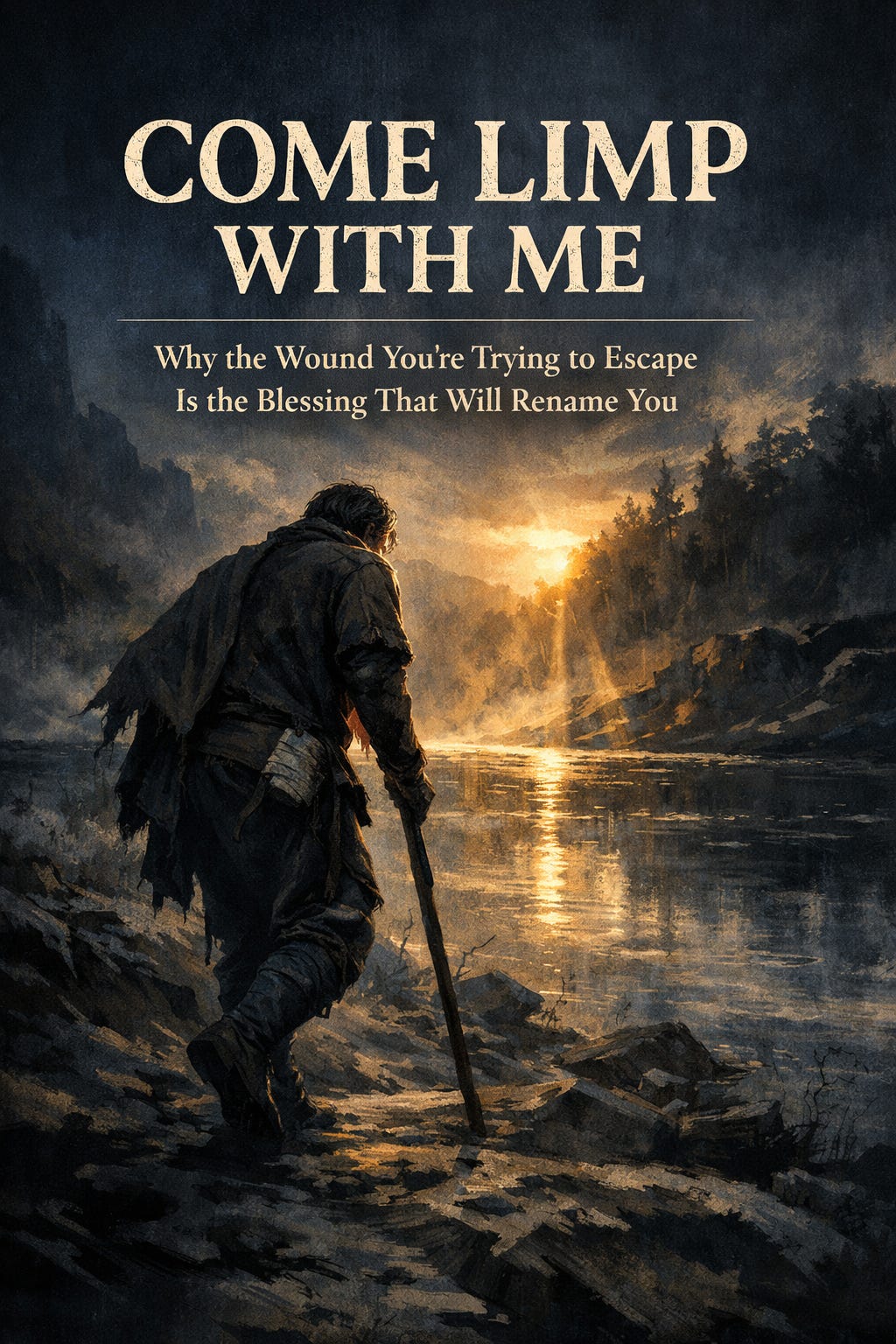
There’s a story in Genesis 32 that won’t leave me alone. Jacob spends his entire life surviving on cleverness. Grabbing heels. Bargaining for blessings he hasn’t earned. Outmaneuvering people instead of facing them. And it works. Until one night it doesn’t.
He finds himself alone at the edge of a river, in total darkness, wrestling something he cannot see, cannot name, and cannot outsmart. No audience. No angle to play. No version of himself that’s useful anymore. That’s the most terrifying place a human being can stand — not in the presence of an enemy, but in the absence of every mask that ever made you feel safe.
Then something clinical happens. He’s grabbed at the hip — the joint that drives every step forward — and it breaks. Not his spirit. Not his pride. His ability to move through the world the way he always has. The man who built his life on motion cannot walk. The man who survived by leaving cannot leave. I recognize that. I know what it feels like when life grabs the bery place your false confidence lives and says, no. You don’t get to outrun this one.
This is the moment the ego meets its limit. The false self doesn’t dissolve gently. It shatters. And we experience it as failure, as loss, as the nauseating freefall of realizing the person we’ve been performing as cannot carry us where we need to go. Most people never recover from this moment. Not because the pain is too great, but because the identity loss is. We would rather let go of the blessing than let go of who we think we are.
But Jacob does something that defies every survival instinct he’s ever had. After the breaking— he holds on tighter. Before the wound, holding on is strength. After the wound, holding on is surrender. It’s the raw admission that I need something I cannot earn, cannot take, and cannot manufacture. And receiving requires staying in the one place my entire personality was engineered to escape.
I think about how many times I’ve released my grip right at that threshold. How many times the pain pressed against my identity — my need to be capable, my terror of being exposed as someone who doesn’t have it figured out — and I called my retreat wisdom. I dressed my running in the language of healing. I said I was “letting go” when I was just protecting the version of me that was never going to make it to the other side anyway.
Rumi taught that our deepest wounds — heartbreak, loss, the failures that make you want to disappear — are not dead ends. They are cracks in the armor of the ego. And those cracks are not damage. They are openings. They create the necessary space for wisdom, compassion, and a kind of awareness that comfort will never produce. He wrote, “The cure for the pain is in the pain” — not beyond it, not waiting on the other side of some imagined healing, but woven into the thing you’re trying to survive. Then he said something that stops me: “What hurts you, blesses you.” Not what hurt you looking back with perspective. What hurts you. Present tense. The pain you are in right now is doing something nothing else can. It is building a resilience that ease never could. It is teaching you who you are when every comfortable lie has been stripped away.
Jacob stays. Shattered hip. No pretense left. And in that total vulnerability, he does something he’s never done — he names his need out loud. “I will not let you go until you bless me.” This is not the demand of a strong man. It’s the prayer of a broken one. And only after the wound, the surrender, the raw admission of need, does he receive a new name. Israel. Not “the one who won.” The one who wrestled with God and stayed.
Names change only after costs are paid.
The story doesn’t end the way we’d write it. Jacob limps into the morning. He will limp for the rest of his life. Everyone who meets him will see it — the uneven gait, the visible evidence that something happened to this man he could not control. The blessing did not erase the wound. The wound is the proof the blessing was real.
I believe this is the architecture of being human. Not to find a life without struggle, but to find the struggle that is specifically yours — the wound with your name on it, the ache no achievement can quiet — and to hold on until it blesses you. Not to romanticize suffering. But to stop running from the particular suffering that is trying to remake you.
Every one of us has a dark riverbank. A wrestle we keep postponing. A breaking we keep negotiating our way around. Maybe the point was never to arrive intact. Maybe it was to stay long enough — past the breaking, past the silence of not knowing who you are anymore — to be renamed.
The limp is not the cost of the blessing.
The limp IS the blessing.
And the pain you’ve been trying to escape?
It was the doorway the whole time.
Come limp with me.
Blessings.
Afshine Ash Emrani, M.D., F.A.C.C.
Assistant Clinical Professor, UCLA
David Geffen School of Medicine
Castle-Connolly Nationwide Top Doctor (Since 2008)
Los Angeles Magazine Super Doctor (Since 2010)
LA Style Magazine Top 100 Doctors in America (2024)
Subscribe to mynewsletter: substack.com/@afshineemrani
Explore my books: Amazon Author Profile
So beautiful and noble. Thank you.