

Somewhere right now, someone is reconstituting a peptide they bought from a website that also sells "research chemicals," following a protocol they saw in a 40-second clip, injecting it into their abdomen, and telling themselves it's basically a vitamin. They've heard the miracle stories. They've never heard the other half. And in a few weeks, the U.S. government is going to make this whole thing legal — which means millions more people are about to do the exact same thing. I'm a cardiologist. I think the science here is genuinely extraordinary. I also think the way most people are about to use it could quietly hurt them. So let me give you the version I'd give a patient sitting across from me — both halves, the way it should always be told.
I’m a cardiologist. I spend my days reading the body’s quietest signals — the EKG tracing, the lipid panel, the inflammatory marker that whispers trouble years before the heart attack speaks. So when a class of molecules built entirely out of signaling suddenly moves to the center of American medicine, I pay attention.
And right now, something is moving.
For the first time since 2023, the regulatory ground beneath peptides is shifting — and almost everyone is learning about it from the worst possible sources. TikTok hustlers. “Research-use-only” websites. Podcast clips stripped of every caveat. I want to give you the version I’d give a patient sitting across from me in my office. No hype. No bro-science. Both halves of the truth, as always.
Because the promise here is real. And so is the danger. And anyone selling you only one of those is not your friend.
What actually happened
On February 27, 2026, on the most-listened-to podcast on the planet, HHS Secretary Robert F. Kennedy Jr. said out loud what the longevity world had been praying for: that roughly 14 of the 19 peptides the FDA buried on its Category 2 “do-not-compound” list in 2023 would be moved back toward Category 1.
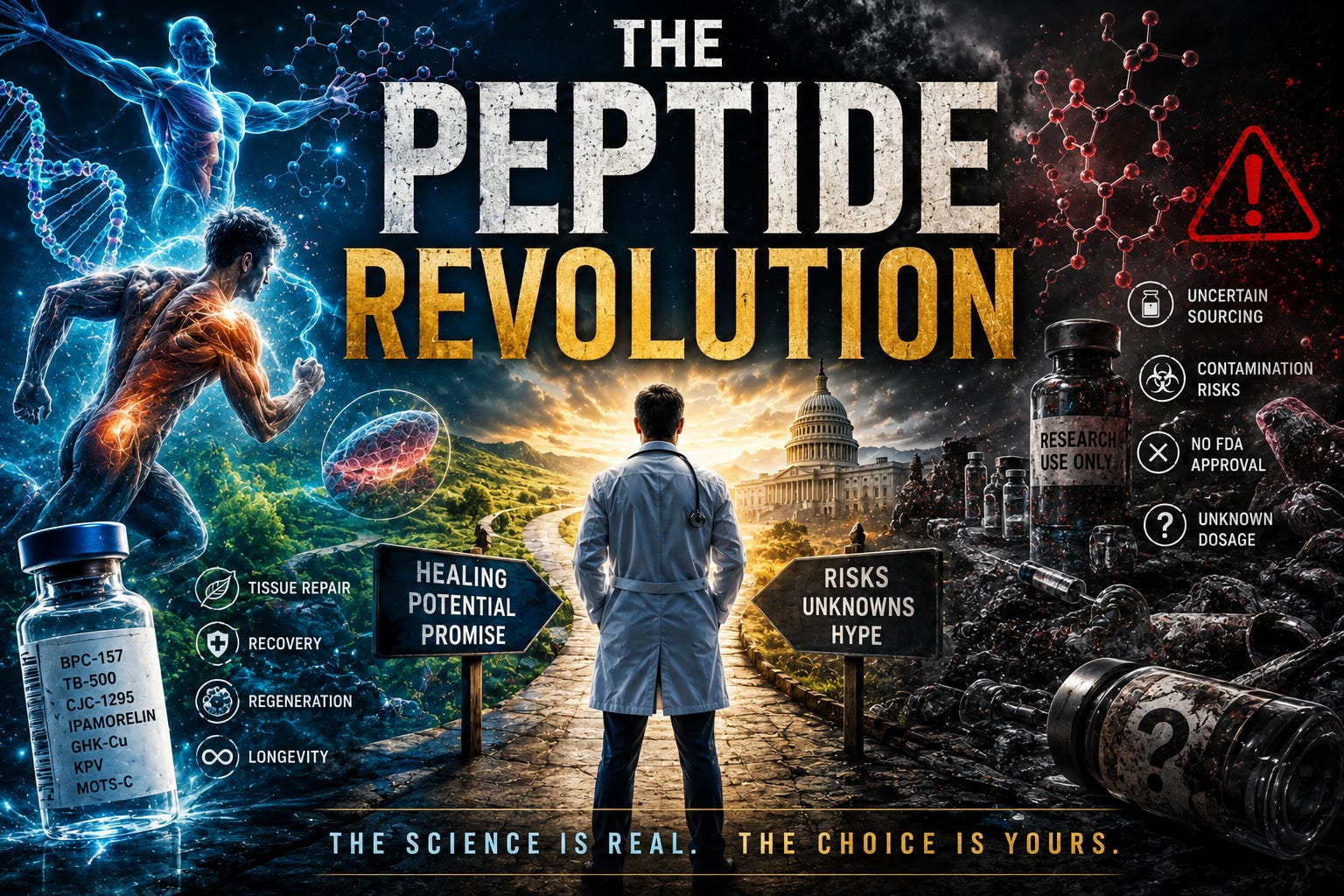
Translation, in plain English: peptides like BPC-157, TB-500, CJC-1295, Ipamorelin, GHK-Cu, KPV, and MOTS-C could once again become legally available — prepared by licensed compounding pharmacies, under a physician’s prescription, for the first time in years.
The FDA’s Pharmacy Compounding Advisory Committee is scheduled to formally review these compounds at its meeting on July 23–24, 2026. That date is the hinge. That is the moment the legal and quality landscape could genuinely change.
But hear me carefully, because the headlines are already lying to you: it hasn’t happened yet. As of this writing, the FDA has not published a formal updated list. BPC-157 is still, today, sitting on Category 2. “RFK unbanned peptides” is a screenshot, not a fact. What we have is a signaled intention and a review on the calendar — not a finished rule.
This is a genuine turning point in regenerative medicine. It is also the precise moment when misinformation can do the most damage, because demand has been exploding through gray-market channels for years, and people are about to make decisions about their bodies based on a podcast clip.
So let me give you both halves.
The promise is real
I don’t say this lightly. The biology of these molecules is some of the most elegant I’ve encountered in twenty years of medicine. These aren’t sledgehammers. They’re letters in a language the body already speaks — signaling molecules that amplify your own repair machinery rather than flooding the system with foreign pharmacology.
BPC-157 — a fragment derived from a protein in human gastric juice — has shown remarkable preclinical results in tissue repair, gut-lining restoration, the growth of new blood vessels, and the dampening of inflammation. Animal models show accelerated healing of tendons, ligaments, muscle, and intestinal tissue. The reports from physicians and patients — soft-tissue injuries resolving faster, stubborn gut conditions quieting down, recovery that’s hard to explain away as placebo — are genuinely compelling.
TB-500 — thymosin beta-4 — drives cell migration, calms inflammation, and supports cartilage and tendon repair. Stacked with BPC-157, it has become the single most-discussed regenerative protocol in longevity medicine.
GHK-Cu — a copper-binding peptide — shows antioxidant, tissue-remodeling, and anti-aging activity in preclinical work, with applications in skin, hair, and wound healing.
Ipamorelin and CJC-1295 — growth-hormone secretagogues — coax the body into its own natural GH pulses instead of injecting exogenous hormone. The reported payoffs: deeper sleep, better recovery, body composition, muscle preservation.
KPV — a small anti-inflammatory peptide — is generating real interest for gut inflammation and immune modulation, including in cases where conventional anti-inflammatories have failed.
The preclinical data across this class is fascinating. The mechanisms are beautiful. If you have a scientific bone in your body, it’s hard not to feel the pull.
And that pull is exactly where the danger begins.
Now the half nobody wants to hear
Here is the sentence the influencers will never put in their reel:
There are no large, randomized, controlled human trials for any of the recovery and longevity uses driving today’s demand. Not one.
The preclinical data is promising. The anecdotes are compelling. But the canyon between “it healed a rat’s tendon and my buddy swears by it” and “proven safe and effective in humans, at these doses, for these indications” has not been crossed. Promising is not proven. A signal is not a study. As a cardiologist, I have watched too many “obvious” therapies collapse under the weight of an actual trial to confuse enthusiasm with evidence.
The gray market is a real hazard — not a theoretical one. Independent laboratories that test “research-grade” peptides sold online keep finding the same thing: a meaningful fraction fail basic purity and dosing standards. Estimates run from 20% to 40% of research peptides failing pharmaceutical purity benchmarks, and one lab’s analysis of more than 1,200 samples found the majority came in below the purity their own certificate claimed — many off by more than ten percentage points. What does that mean in practice? Wrong peptide content. Bacterial contamination. Endotoxins. Heavy metals. Residual manufacturing solvents. When you buy a vial stamped “for research use only” from an unregulated website, you have no guarantee that what’s inside the glass matches what’s printed on the label. You are, quite literally, injecting an unknown.
Kennedy himself acknowledged the core irony: the Category 2 restrictions didn’t kill demand. They pushed patients toward these unregulated sources, with zero pharmaceutical oversight. Part of the entire point of reclassification is to drag these compounds back under quality-controlled compounding and physician supervision — to replace the back alley with a pharmacy counter.
The side effects are real and badly underreported. Online peptide content is a highlight reel; it shows you the upside and edits out the cost. In real clinical practice we see nausea, GI disruption, injection-site reactions, headaches, water retention, joint-pain flares, mood changes, and hormonal disruption.
And two warnings deserve to be set in bold and read twice:
BPC-157 promotes angiogenesis — the growth of new blood vessels. That is precisely why it heals. It is also a double-edged sword. The same mechanism that feeds a recovering tendon could, in theory, feed a tumor that wants a new blood supply. Anyone with a history of cancer should approach BPC-157 with extreme caution and discuss the theoretical risk explicitly with their oncologist — not their group chat.
Growth-hormone secretagogues affect insulin sensitivity and blood-sugar regulation. That sits directly in the lane of the metabolic health I monitor in my patients every single day. These are not consequence-free.
Reclassification is not approval — and this matters
Let me kill the most dangerous misunderstanding before it spreads any further.
Even if every one of these peptides moves to Category 1 in July, they will still be unapproved drugs. They remain available only through licensed compounding pharmacies, under physician supervision, for individual patients. Category 1 is not an FDA stamp of safety and efficacy. It is a doorway to quality-controlled, supervised access — not a green light to self-dose from an internet vendor, and not a validation of every protocol circulating on Reddit.
The regulatory shift creates a legal, monitored pathway. That is good. It is also the entire extent of what it does.
What I’d tell my own patients right now
Wait for the July review. The regulatory clarity coming in a matter of weeks could change what’s legally available, and at what quality standard. Don’t start something new chasing a headline when the real answer is around the corner.
If you’re already using peptides, demand the paperwork. Insist on a batch-specific certificate of analysis with mass-spectrometry identity confirmation and endotoxin testing. If your source can’t or won’t provide it, you are injecting a mystery.
Never start a peptide protocol without physician oversight and baseline bloodwork — hormones, liver and kidney function, fasting insulin, inflammatory markers. Establish your baseline. Then monitor throughout. Numbers, not vibes.
If you have any history of cancer, treat angiogenesis-promoting peptides like BPC-157 with the highest caution, and have the explicit conversation with your oncologist before anything else.
Cycle intelligently. These are signaling molecules, not vitamins. The biology works best in targeted courses — not indefinite daily use.
And never, ever let peptides replace the foundation. Sleep seven to nine hours. Lift heavy things. Eat real food. Manage your stress. Do the unglamorous metabolic work I write about every week on this platform. Peptides amplify a healthy system. They cannot rescue a broken one. A signal sent into a body that is poisoning itself with sugar, sleeplessness, and stress is a candle lit in a flooded room.
Both halves
The peptide revolution is real. The biology is genuinely fascinating. After years of prohibition pushing patients into the shadows, the regulatory landscape is finally catching up to the demand — and there is something almost just about restrictions giving way to supervision instead of secrecy.
But the difference between a clinical tool and an unregulated gamble comes down to three things and three things only: physician supervision, pharmaceutical-grade sourcing, and an honest accounting of what the evidence does and does not yet support.
The body is the most sophisticated healing system ever assembled — a vessel built, I believe, with intention. These molecules don’t override that wisdom. At their best, they whisper to it. Our job is to make sure the whisper is clean, supervised, and true — and not a stranger’s voice in the dark, sold to us by someone who profits whether we heal or not.
Both halves. As always.
Blessings.
Afshine Ash Emrani, M.D., F.A.C.C.
Assistant Clinical Professor, UCLA
David Geffen School of Medicine
Castle-Connolly Nationwide Top Doctor (Since 2008)
Los Angeles Magazine Super Doctor (Since 2010)
LA Style Magazine Top 100 Doctors in America (2024)
Subscribe to mynewsletter: substack.com/@afshineemrani
Explore my books: Amazon Author Profile