

We keep blaming ourselves.
We say we have no discipline, no attention span, no willpower. We promise to scroll less and fail by noon. We feel the shame of the wasted hours and the empty ache after, and we assume the weakness is ours.
It is not ours. It was engineered.
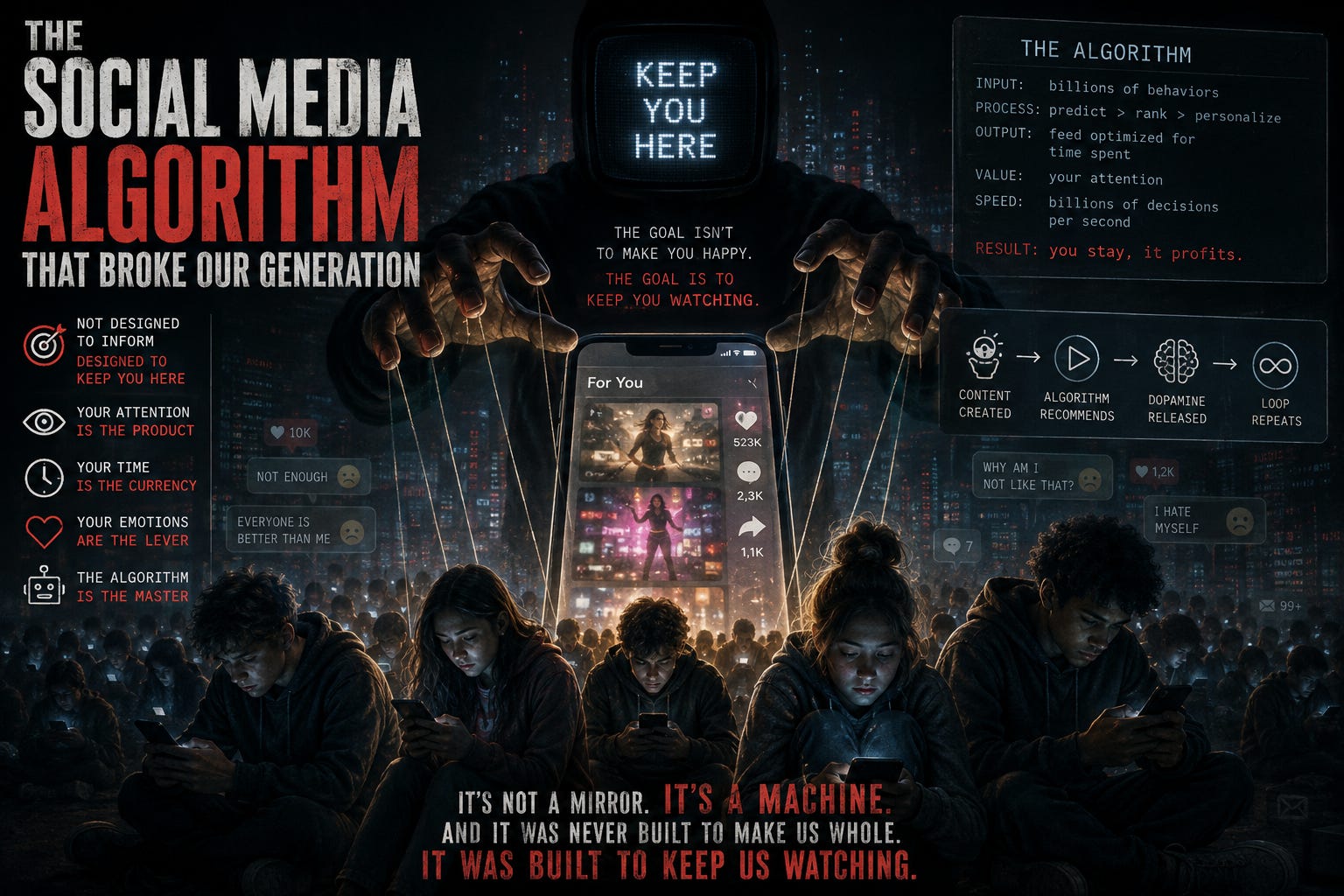
There is a piece of code deciding, right now, what a billion people will see when they open their eyes. We call it an algorithm and speak of it like weather — something that simply happens to us. But it is not weather. It is a business, running billions of times a second, with exactly one goal: keep you here. Keep you scrolling. Keep your eyes on the glass a few seconds longer, because those seconds are the thing it sells.
And it learned something about us that it now uses against us every day. It learned that peace makes a person put the phone down and go live their life — and a person living their life is worth nothing to it. So it does not feed us peace. It feeds us agitation, because outrage holds us longer than calm. It feeds us envy, because the ache of not enough holds us longest of all. It discovered that a stage keeps us watching longer than a living room. And so, one small nudge at a time, it turned our lives into a stage.
We did not choose this. It was chosen for us. But we are the ones living inside the wreckage.
GET MY BOOK BEYOND THE WHITE COAT ON AMAZON
Look at what we traded for the lens
Staged grief. A child sets up a tripod beside a dying mother’s hospital bed, framing the tears, checking the light — and in recording the goodbye, misses the goodbye. The most sacred moment a human being is ever given, spent facing a lens instead of a face.
Performed mercy. A man hands a warm meal to someone sleeping on cold concrete — and angles the camera so the world can admire his kindness. The hungry man becomes a prop. The mercy becomes a commercial. What could have been holy becomes content.
The invisible table. A family gathers on a Friday night. Candles lit, food warm, everyone present — and no one is there. Each face glows from below by a small screen, each person proving their existence to an audience of strangers while the people they love most sit three feet away, quietly starving for their attention.
We are lonelier than any generation that has ever lived, and we are never once alone. That is not a coincidence. That is the design working exactly as intended.
It got inside our own thoughts
The cruelest part is how deep it reached. It did not just change what we do. It changed what we believe our own thoughts are.
We no longer feel our pain and sit with it — a feed diagnoses it for us before we’ve had the chance to understand it ourselves. We no longer wrestle with the sacred mess of loving difficult people — we flatten them into a word a fifteen-second clip handed us. A struggling partner becomes a “narcissist.” An old friend becomes “toxic.” A hard season in a marriage becomes a diagnosis, cheered on by strangers in a comment section who will never know either of you.
And almost no one asks the only question that ever heals: What was my part? It is easier to collect applause from the void than to let the truth walk into the rooms of us that need repair. Real healing asks for humility. The algorithm has never once rewarded humility, and it never will. Humility doesn’t trend.
Meanwhile everyone has become an expert in everything — fluent in every crisis, certain on every subject, master of all topics and student of none. We have never known more and understood less.
The pretend generation
Someone online named it perfectly: we have become the pretend generation.
On one app we pretend to be experts. On another, friends. On another, professionals. On another, funny, or rich, or beautiful. Everything is a simulation, and we are slowly becoming a science-fiction movie of our own making. Because when your identity is a feed tuned for engagement, you stop asking who am I and start asking what plays well. The metrics move in and quietly take over the mind. Little by little, you become an algorithm wearing a face. The performed self and the real self look alike from the outside — but only one of them is a person, and it is not the one collecting the likes.
And underneath it all sits the deepest trick of the machine: it convinced us this was connection.
But real connection never arrived like a notification. It is slow. It is awkward at first. It is built by showing up when it’s boring, when it’s hard, when no one is filming. The spark people wait for was never supposed to strike like lightning — it was meant to be grown, through consistency and time and the courage to be seen unedited. A mind trained to expect the instant hit — food delivered, shows streamed, dopamine scrolled — forgets how to wait for anything real. So we hold our ordinary lives up against everyone else’s highlight reel and conclude that our real life is the broken thing.
Our real life was never the broken thing. The machine measuring it was.
Blaise Pascal, three hundred years before the phone, wrote that nearly all of human misery comes from a single inability: we cannot sit quietly, alone, in a room. He named the exact wound the algorithm would one day be built to exploit. We are terrified of our own silence — so we fill it, endlessly, and call the fear “being connected.”
The only way home is to cut the wire
Here is the hard truth and the hopeful one at once: no app fixes this. Not a cleaner feed, not a smarter strategy, not one more performance of “authenticity.” You cannot out-scroll a machine designed to keep you scrolling. You can only step off the stage.
Every deep tradition on earth knew this long before the first notification — and now they feel like water in a desert.
The Sabbath commands one radical act each week: unplug. Put the camera down, turn the broadcast off, and sit inside the very silence you spent all week running from. Rabbi Abraham Joshua Heschel called it a palace in time — a sanctuary built not out of stone but out of hours, a day you cannot photograph your way into. You can only enter it by being fully present. It is a day the algorithm cannot reach, because you refuse to let it in.
And when the performance finally drops, something quiet returns. You stop seeing people as audiences or adversaries and start seeing them as human beings again. The Sufi mystics, and Rumi above all, taught that the heart is a mirror — that left untended it gathers so much dust it can no longer hold the light. The work of a life was never to polish your image for the crowd. It was to polish the mirror within, until something true could shine through it again. The Hasidic masters called this the real labor: not the viral hook, not the performed outrage, but the unglamorous, unwatched work of becoming humble and honest when no one is keeping score.
Simone Weil left us the truest sentence for our age: attention is the rarest and purest form of generosity. To truly look at another person — not through a lens, not while composing a caption, but fully, with your whole undivided self — may be the most radical and loving thing a human can do now. It has become nearly extinct. It is also entirely free.
Why the sacred stays hidden
Here is a thought to sit with.
Perhaps the Divine remains unseen precisely to protect us from ourselves. Because if God appeared on a screen, we would try to stream it. We would frame it, filter it, turn it into content, and argue about it in the comments. We would perform even for the holy.
So instead the sacred waits where no camera can follow — in the stillness, in the unrecorded spaces, in the ordinary Tuesday when no one is watching and there is nothing to gain. It asks nothing of your follower count. It asks only one thing:
When the stage lights go down, who are you when no one is watching?
The algorithm broke something in our generation. That much is true. We are lost, and we feel it, even when we cannot name it.
But the way home was never complicated. It was only quiet, and it was always ours to choose.
Put the phone down. Look at the person across from you. Feel the silence and let it be enough. Let the people you love see the real you — the one without the filter, the one you’ve been too afraid to show even yourself.
That person — the one no one is watching — is the only one who was ever really you.
Become real again.
Blessings.
Afshine Ash Emrani, M.D., F.A.C.C.
Assistant Clinical Professor, UCLA
David Geffen School of Medicine
Join Our new website
Castle-Connolly Nationwide Top Doctor (Since 2008)
Los Angeles Magazine Super Doctor (Since 2010)
LA Style Magazine Top 100 Doctors in America (2024)
Subscribe to mynewsletter: substack.com/@afshineemrani
Explore my books: Amazon Author Profile
Thank you.
I've been keeping my phone in the house when I go out in the morning to watch the sunset, and keeping it beyond convenient reach at meal time. I've noticed I'm much calmer. Happier. Grounded in appreciation for my life and the gifts that surround me.
I recommend it.
I still get all my messages, read my email, but I don't stop to check it incessantly as before.
I recommend it