
The Tiny Monkey Who Taught the World to Hold On
A rejected baby monkey clutching a stuffed doll just explained your loneliness better than any therapist ever has.

There’s a seven-month-old monkey in Japan named Little Punch.
His mother rejected him at birth. When zookeepers tried to introduce him to the other monkeys, they bullied him and pushed him away. He had no one.
So he found a stuffed orangutan doll — and he held on to it like it was the whole world.
He carried it everywhere. Dragged it across the enclosure floor. Slept clutching it to his chest. That little toy was his mother, his friend, his comfort, his everything.
And when people saw it — something broke open in them.
Because we’ve all been Punch.
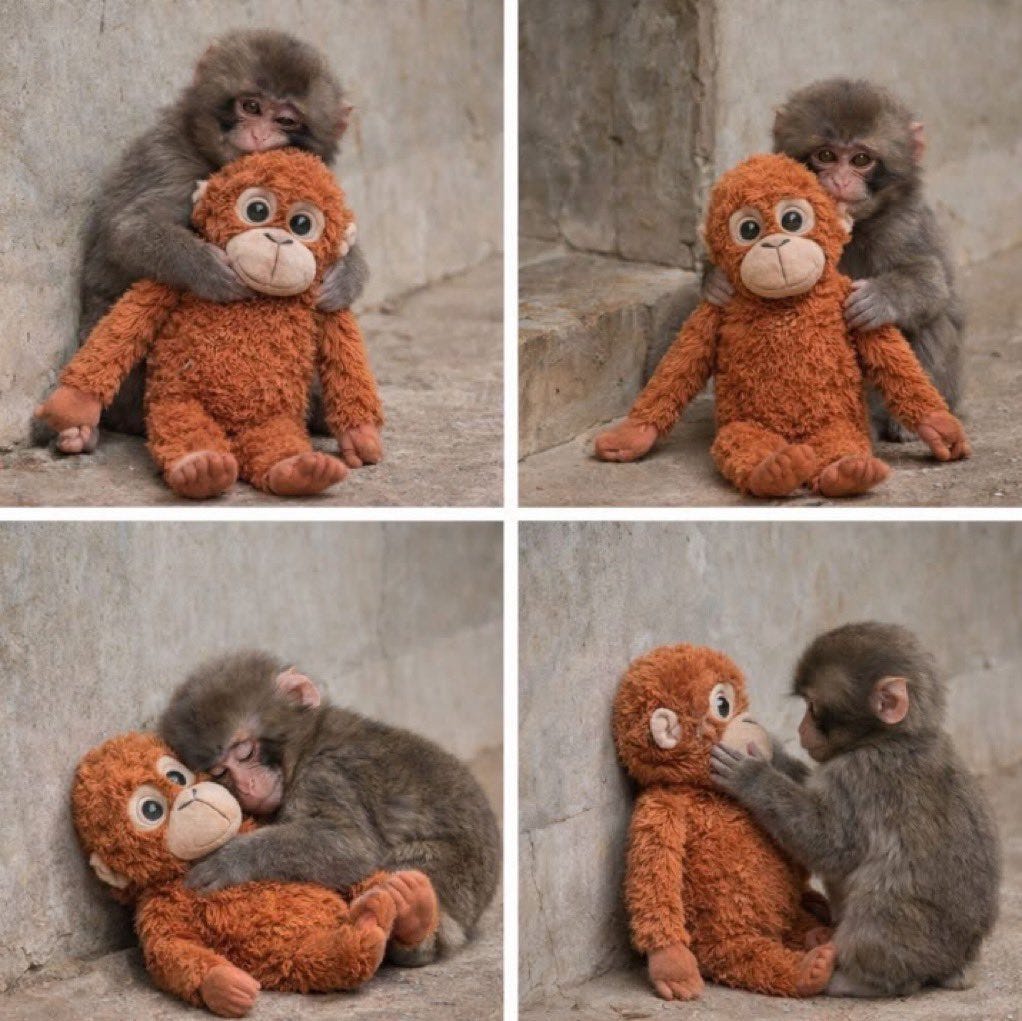
We’ve all been rejected by someone we needed.
We’ve all sat alone in a crowd wondering why we don’t fit in. We’ve all held on to something small — a song, a routine, a memory — just to get through the day. We’ve all been the one standing at the edge of the group, watching everyone else belong to each other.
That’s why millions of people around the world couldn’t stop watching this tiny monkey.
He wasn’t just cute. He was us.
But here’s where the story gets really good.
Punch didn’t give up. He kept showing up. Day after day, bruised and rejected, he stayed in that enclosure and he kept trying.
And then one day — an adult female monkey walked over to him.
She looked at him. And she pulled him in and held him.
Just like that, he had a mom.
Soon after, he started making friends. Started playing. Started slowly, tentatively, setting down the stuffed doll — because he didn’t need it quite as much anymore. Real arms had replaced it.
The whole world exhaled.
Here’s what this little monkey quietly teaches us:
Your comfort object is not weakness. Whatever you’ve been clinging to during hard times — your journal, your music, your long walks, your one friend who always picks up — that’s not embarrassing. That’s survival. That’s you being smart enough to hold on until something better arrives. Hold on to it without shame.
Rejection is not the final verdict. It feels like it is. It really does. But Punch was rejected over and over, and it still wasn’t the end of his story. The door that closes loudly is never the last door. Keep walking down the hallway.
Vulnerability is what lets love in. Punch didn’t hide his loneliness. He wore it openly, dragging that little doll around for everyone to see. And that openness is exactly what made people root for him — and what made that mama monkey notice him. When we pretend we’re fine, we become invisible to the people who might have held us. Our need, honestly worn, is what draws love toward us.
One person is enough to change everything. It didn’t take the whole troop. It took one female monkey who decided he was worth protecting. Think about that. One person choosing you — really choosing you — can rewrite your whole life. Be that person for someone. And trust that person is out there coming for you.
Healing is slow and that’s okay. Punch didn’t drop the doll on day one of making friends. He held onto it for a while longer, just in case. He eased into trust. He took his time. That’s not weakness either. That’s wisdom. You don’t have to heal on anyone else’s timeline.
We live in a world that can feel impossibly cold sometimes.
Jobs lost. Friendships that quietly fell apart. Families that don’t understand us. Rooms we walk into and still feel alone in. The particular ache of being surrounded by people and still feeling like nobody sees you.
And then a tiny monkey in a Japanese zoo drags a stuffed doll across the ground — and somehow, that is the thing that cracks us open.
Because it reminds us of something we keep forgetting:
The need to belong is not a flaw. It is the most human thing there is.
We are not meant to make it alone. Not the monkeys. Not us. Every single person you pass today is carrying some version of that little stuffed doll — something they’re holding onto just to get through, just to feel less alone, just to make it to the day when someone finally wraps their arms around them and says: you’re safe now. You belong here.
Little Punch has a mom now. He has friends. He still carries the doll sometimes — out of habit, or love, or maybe just because it got him this far.
And somewhere out there, your troop is coming.
Hold on.
Blessings.
Afshine Ash Emrani, M.D., F.A.C.C.
Assistant Clinical Professor, UCLA
David Geffen School of Medicine
Castle-Connolly Nationwide Top Doctor (Since 2008)
Los Angeles Magazine Super Doctor (Since 2010)
LA Style Magazine Top 100 Doctors in America (2024)
One of the less obvious takeaways here is the argument that openly showing need is what actually draws the right people in, not what repels them. That cuts against a lot of conventional 'fake it till you make it' social advise telling you to project confience at all costs. I've seen this play out in my own life; people I'm closest to came through after moments where I stopped pretending to be fine. Punch dragging that doll around is kind of a perfect image for that idea.