

In a single week, four separate advances in biology and medicine were announced, and the stock market treated them as four unrelated events. They are not unrelated. They are four expressions of the same underlying change — a shift in what medicine fundamentally is and how it works.
For all of history, medicine has been built around the average patient: the average dose printed on a label, the average risk calculated from a population study, the standard treatment that works for most people in the middle of the curve. This was never a philosophical choice. It was a limitation. We simply did not have the tools to read and rewrite biology at the level of a single individual, so we treated everyone according to the average and adjusted by trial and error.
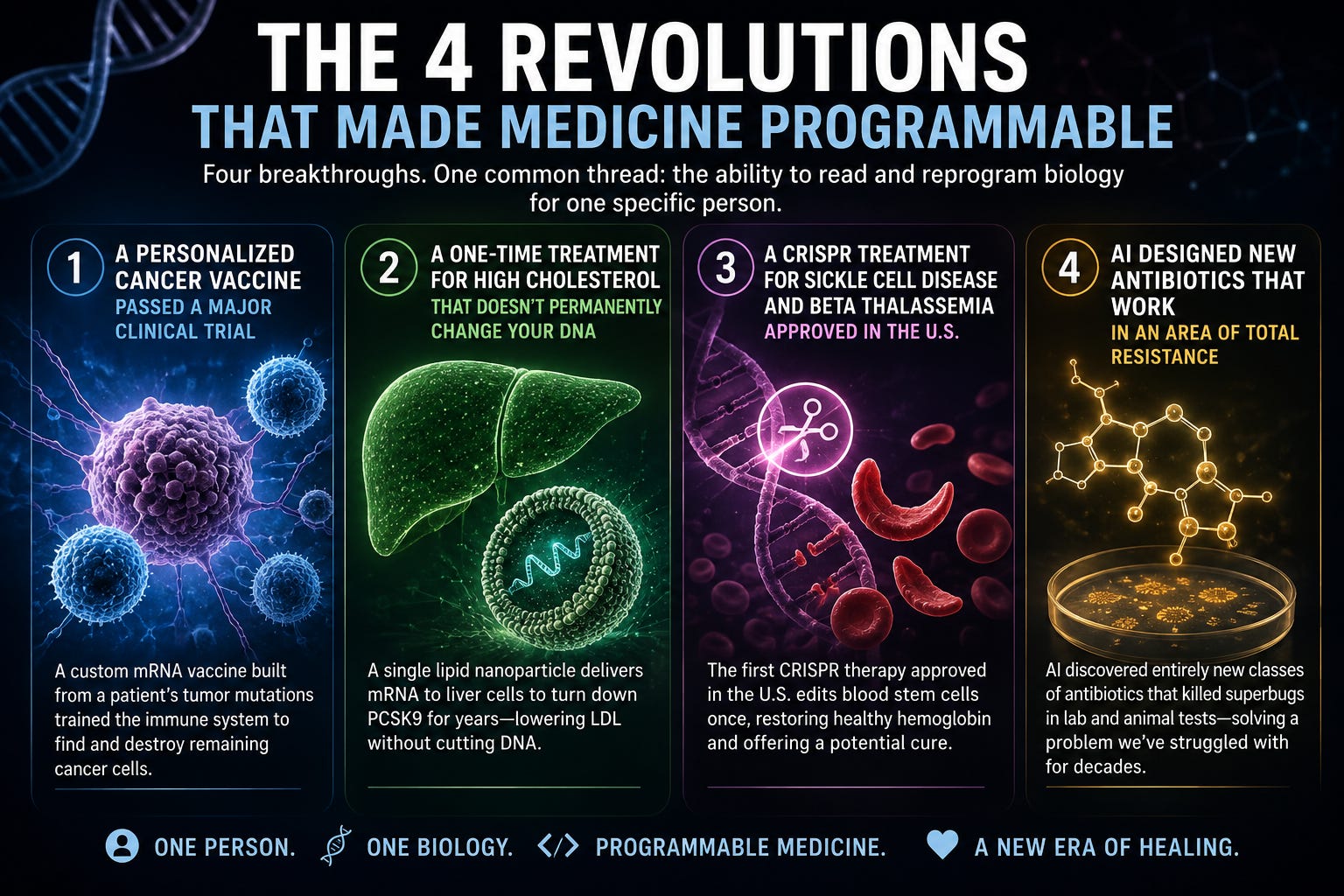
That limitation is now falling away. The common thread running through all four of this week’s announcements is that we are gaining the ability to build medicine for one specific person — to read an individual’s biology precisely, and increasingly to reprogram it. This article explains each breakthrough in plain terms, how each one actually works, and how they connect into a single trend. I’ll keep it accurate rather than dramatic, and I’ll be clear about what is proven and what is still early.
Let’s take them one at a time.
1. A personalized cancer vaccine passed a major clinical trial
What it is. A cancer “vaccine” that is custom-manufactured for one patient, based on the specific mutations in that patient’s own tumor. Note the word “vaccine” is somewhat misleading here: this does not prevent cancer the way a flu shot prevents flu. It is a treatment, given after surgery, to stop an existing cancer from coming back.
How it works, step by step. This is the part worth understanding, because it’s genuinely different from older cancer treatment.
First, surgeons remove the tumor. Scientists then sequence the tumor’s DNA and compare it, letter by letter, to the DNA of the patient’s healthy cells. Cancer arises from accumulated genetic mutations, and those mutations cause the cancer cells to produce abnormal proteins — called neoantigens — that appear on cancer cells and essentially nowhere else in the body. These are, in effect, molecular flags unique to that person’s cancer. No other patient’s tumor carries the same set.
Next, a computer algorithm analyzes those mutations and selects up to about 34 of them that the patient’s immune system is most likely to be able to recognize and attack. Those selected targets are encoded into a strand of messenger RNA (mRNA) — the same class of molecule used in the COVID vaccines — wrapped in a tiny fat particle called a lipid nanoparticle, and injected. The patient’s own cells read the mRNA and briefly display the cancer’s molecular flags, which trains the immune system’s T-cells to recognize and destroy any cell carrying them. The vaccine is given together with a second drug (Keytruda, a checkpoint inhibitor) that removes a molecular “brake” cancers use to hide from the immune system, so the newly trained T-cells can finish the job.
The result. In a Phase 3 trial of 1,137 patients with high-risk, surgically removed melanoma, the personalized vaccine plus Keytruda outperformed Keytruda alone: it reduced the rate of cancer recurrence and reduced the rate of spread to distant organs. This is the first time in medical history that an mRNA-based cancer therapy has succeeded in a Phase 3 trial. Earlier-stage data had shown roughly a 49% reduction in the risk of recurrence or death. Trials in lung, bladder, and kidney cancers are already underway.
The honest limits. The trial measured whether the cancer returned, not yet whether patients ultimately live longer overall — that longer-term survival data is still being collected. The full statistical details (exact hazard ratios and confidence intervals) have not yet been published. And the therapy is complex and expensive to manufacture individually. But the core proof-of-concept — that a made-to-order immune therapy can beat the standard of care in a large randomized trial — is now established.
2. A one-time treatment for high cholesterol that doesn’t permanently change your DNA
What it is. An experimental treatment (from a company called Scribe) intended to lower “bad” cholesterol (LDL) with a single dose that lasts for years, aimed at the world’s leading cause of death: cardiovascular disease.
The background you need. A gene called PCSK9 helps control how much LDL cholesterol stays in your blood. Turn that gene down, and LDL drops substantially. We already know this works — there are two approved drugs (Repatha and Leqvio) that block PCSK9. What’s new here is not the target. It’s the method and the durability.
How it works, and why it’s different from ordinary CRISPR. You may have heard of CRISPR as “gene editing” — molecular scissors that cut DNA to change it. Cutting DNA is powerful, but permanent and risky: mistakes can’t be undone. This treatment does not cut DNA. It uses a deactivated version of CRISPR — the targeting system without the scissors — to place a chemical “off switch” on the PCSK9 gene. This is called epigenetic silencing: the underlying DNA sequence is left completely intact, but a chemical tag tells the cell to stop reading that gene. Because the DNA itself isn’t altered, the effect is designed to be potentially reversible. The whole package — the instructions for the silencing machinery plus a guide that steers it to PCSK9 — is delivered to the liver using the same lipid-nanoparticle technology used in mRNA vaccines.
The result. In non-human primates (monkeys), a single dose lowered LDL cholesterol by more than 50%, and the effect lasted nearly two years and was still ongoing. Higher doses reduced LDL by as much as 67–68%. Liver function stayed normal.
Why this matters. Today, preventing heart disease means taking pills every day, often for decades. But roughly half of patients stop taking their cholesterol medication within a year — and every gap allows more plaque to build in the arteries. This “adherence gap” is a major, well-documented cause of preventable heart attacks. A single treatment that holds cholesterol down for years would bypass that problem entirely.
The honest limits — and these are big. This is still animal data. The therapy is only now entering its first human trial, which is designed primarily to test safety, not to prove it works in people. Many treatments that look excellent in monkeys disappoint in humans. So this is a promising direction, not a proven therapy. It is the least clinically advanced of the four breakthroughs here — but potentially one of the most consequential if it holds up.
3. Artificial intelligence designed working proteins — confirmed in a real laboratory
What it is. AI models (from Anthropic — the company that also makes the assistant this article was drafted with; the results were independently verified by outside labs) were used to design brand-new proteins from scratch, and those designs were then physically built and tested.
What a “protein binder” is, and why it’s important. Many modern drugs work by binding — latching tightly onto a specific target molecule in the body to block it, activate it, or change what it does. A “binder” is a small protein engineered to grip a chosen target. Designing a good one from scratch (called de novo design) has traditionally required a trained protein engineer months of painstaking work per target. It is one of the foundational, rate-limiting steps in developing new medicines.
What actually happened. The AI was given a set of 15 biological targets and tasked with designing binders for all of them, working largely on its own — researching each target, choosing where to bind, running specialized design tools, and ranking its best candidates. Then two independent contract laboratories, Adaptyv Bio and Twist Bioscience, physically synthesized the AI’s designs and tested them in the lab, without modification.
The result. The designs successfully bound their targets in 14 of the 15 cases, with an overall success rate around 27% — more than double the 10–15% typical of standard industry campaigns. On one difficult target, the AI achieved a 40% success rate, compared with under 4% for human entrants in a prior competition on the same target.
Why it matters, and the honest limit. The significance is speed: a step that used to take months can now be compressed into an afternoon, and the results survived real-world laboratory testing rather than existing only on a screen. The important caveat is that a protein that binds its target is only the first step toward a drug. It still has to prove it is safe, stable, and effective inside a living body — the long and difficult part. But the design bottleneck that gated everything downstream is easing dramatically.
4. The monitoring layer: tracking microscopic disease in a tube of blood
What it is. A quieter set of advances — companies integrating genetic sequencing, artificial intelligence, and “liquid biopsy” into single platforms. This got less attention, but it is what makes the other three usable in practice.
The problem it solves. Suppose you can now build a personalized cancer vaccine or a one-time gene therapy. You still need a way to know, in real time, whether it’s actually working — ideally long before a tumor grows large enough to appear on a scan. You need a way to see inside the body between doctor visits.
How it works. A liquid biopsy is a blood test sensitive enough to detect the faint genetic traces that cancer cells shed into the bloodstream. By first building a genetic “fingerprint” of a patient’s specific tumor, doctors can then scan the blood at each follow-up for that exact signature — sometimes catching a recurrence months earlier than imaging could. If the signal reappears, treatment can begin while the disease is still microscopic and most treatable.
Why it matters. Precision therapy needs precision surveillance. A powerful personalized treatment is far more useful when paired with a sensitive way to measure whether it’s working and to catch any return early. This monitoring layer is what turns a one-time treatment from a gamble into a managed, trackable process.
How these four connect — the actual point
Individually, each of these is interesting. Together, they reveal a single trend, and it comes down to a shared toolkit.
Every one of these breakthroughs is built from the same handful of technologies that also made the rapid COVID vaccines possible: messenger RNA (programmable instructions for cells), lipid nanoparticles (a delivery system to get those instructions into the body), fast genetic sequencing (the ability to read biology cheaply and quickly), CRISPR (the ability to target and now rewrite or silence specific genes), and artificial intelligence (the ability to design biological molecules and interpret complex data). These five capabilities matured at roughly the same time, over the past decade, and this week we saw them applied — separately but simultaneously — to the two conditions that kill more people than anything else on Earth: cancer and cardiovascular disease.
The deeper shift is in the strategy of medicine itself:
In cancer: moving from “remove the tumor, then apply broad treatments and hope” toward “read the tumor’s specific mutations, train the immune system against them, and monitor the blood for any return.”
In cardiovascular disease: moving from “take pills every day for the rest of your life” toward the possibility of a single, durable treatment that addresses a root genetic driver.
In drug development: moving from years of laboratory trial-and-error toward AI-assisted design that produces viable candidates faster, then synthesizing and testing them quickly.
In each case, the direction is the same: from reacting to disease after it appears, toward reading and reprogramming biology to prevent or intercept it — and from treatments designed for the population average toward treatments built for the individual. That is why four “stock stories” are really one story.
What to actually conclude — with appropriate caution
It would be a mistake to read this and conclude that cancer and heart disease are solved. They are not, and honest framing matters.
The personalized cancer vaccine is the most advanced of the four, with a genuine Phase 3 success — but it still owes us long-term survival data and full published statistics, and it is complex to manufacture. The one-time cholesterol therapy is striking but has been demonstrated only in animals so far, and is just now entering its first human safety trial; it could still fail in people, as many promising therapies do. The AI-designed proteins are an impressive and independently verified first step, but binding a target is a long way from an approved drug. And the monitoring tools, while real, are still being validated and integrated into routine care.
In this field, enthusiasm routinely runs ahead of proof, and some of these efforts will stumble. That is normal, and it is worth stating plainly.
But the underlying direction is no longer in question. The tools to read and rewrite biology at the level of the individual now exist and are working, and they are being pointed directly at the diseases that cause the most human death. The wall between “average medicine” and “medicine designed for a specific person” has been breached. What happened this week is not the finish line. It is credible, measurable evidence that the shift is real and already underway.
I write plain-language explanations of what’s actually happening at the frontier of medicine — the science, the mechanisms, and an honest accounting of what’s proven versus what’s still early — without the hype and without the jargon. Subscribe for clear, accurate coverage of the changes that are going to shape how you and the people you love are treated.
Blessings.
Afshine Ash Emrani, M.D., F.A.C.C.
Assistant Clinical Professor, UCLA
David Geffen School of Medicine
Join Our new website
Castle-Connolly Nationwide Top Doctor (Since 2008)
Los Angeles Magazine Super Doctor (Since 2010)
LA Style Magazine Top 100 Doctors in America (2024)
Subscribe to mynewsletter: substack.com/@afshineemrani
Explore my books: Amazon Author Profile
Dr @Afshine Emrani MD FACC , I was independently researching stock $MRNA this weekend as a CANSLIM trader, why it had monster volume footprint. I got blown away on a deep research of how AI got used. I am so happy to see your article confirms that this is likely to leash a wave of monster stocks, $MRNA is the REAL catalyst.
One question is something being worked on the TEA spectrum disorder??