

What They Could Not Finish
When the signal died,
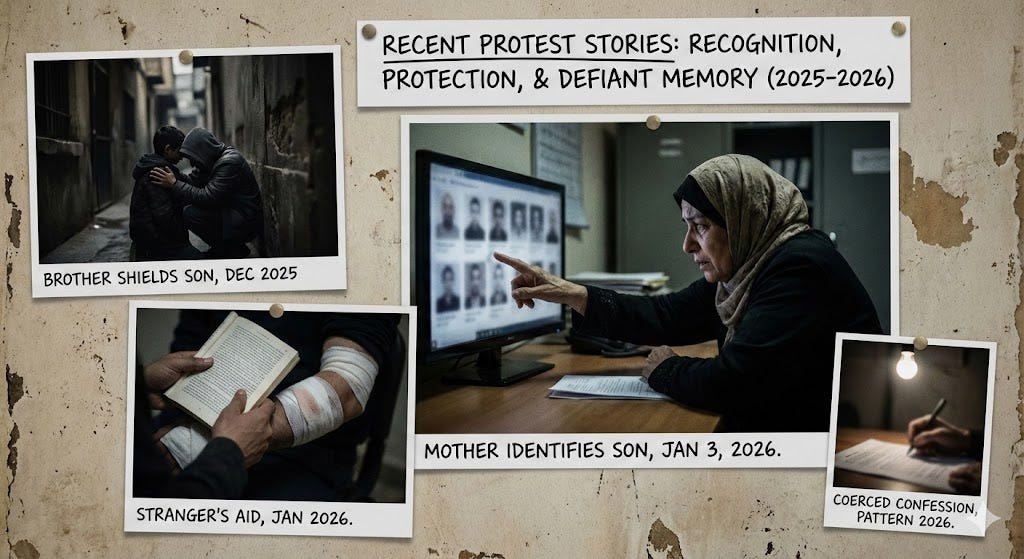
a brother draped himself over his nephew
in a narrow Isfahan alley—
batons cracking the air like green wood splitting,
like the sound a country makes
when it breaks its own children.
They shared breath.
Not prayer. Not courage.
Just counting—
one, two, three—
so neither would vanish
before the other could witness.
The streetlights stayed on.
That was how you knew
this was not chaos.
This was arithmetic.
In Azna, a mother waited
in a police station corridor
where phones were forbidden
and grief was managed like paperwork.
An officer slid photographs across a desk
the way a dealer lays down cards.
She leaned close.
Not crying. Not yet.
She named her son
by what remained:
the curve of his jaw,
the wound she could not look at twice.
Sixteen years old.
They kept the body.
She kept his name—
wore it on her tongue like a stone
she would not swallow,
would not spit out,
would carry until her mouth
became his only grave.
In Rasht, fire moved through the bazaar
like it had been invited,
like it knew which doors to enter.
A vendor felt his keys heavy in his pocket—
thirty years of locking up properly,
thirty years of small ritual—
before the shot took the habit
out of his body.
The keys stayed warm.
The keys did not know
they had outlived their purpose.
In Pasdaran, a boy was carried in
with a face shattered
the way glass collapses
when struck too hard—
not broken, but unmade.
He was still breathing.
Fragments fell from him
as a nurse watched the clock
turn one minute
into the rest of her life.
She did not look away.
That was the first resistance.
At Behesht-e Zahra,
a woman lifted tags in a cold hall—
rows of black bags
stacked like inventory,
like something waiting to be shipped.
Children everywhere.
She found her friend
by the slope of her shoulders,
that familiar bend
she had seen a thousand times
in doorways, in kitchens,
leaning over coffee.
A mother of two.
Shot in the neck.
Stolen once by the street,
again by the state,
taken back now
by the eye that refuses
not to know.
In Isfahan again,
someone pressed cloth against a stranger's wound—
then pages torn from a book
when the cloth ran out.
Ink ran.
Blood followed.
Words dissolved into a body
that could no longer read them.
No one apologized
for not having enough.
The man died held.
That counted.
That was what there was.
In a cell, a blindfolded man
traced words he could not see.
They broke his glasses first—
a small cruelty
before the others.
He signed crimes
his body had already paid for.
Later, when the paper was gone,
he memorized what they made him say
so it could not replace
what was true.
The confession lived in their files.
The truth lived in his spine.
On rooftops in Fardis,
snipers chose heads, chests, routine—
the grammar of suppression,
subject, verb, silence.
Bodies fell in lines.
Motorcycles moved through the gaps
like water through broken glass.
Someone shouted drop the phone.
Someone didn't.
A hand went quiet
before the rest followed.
The footage uploaded anyway.
The dead kept speaking.
A girl tripped while running.
A boy she did not know
put his back against the bullets
and carried her.
No names. No thanks.
Just flight—
two strangers
briefly one animal,
briefly something the state
could not name
and therefore
could not kill entirely.
Inside hospitals,
doctors learned to remember
what could not be written:
three hundred faces,
five hundred wounds,
names etched into the mind
because paper could be seized,
because bodies could be taken,
because forgetting
was the government's final weapon.
They built archives in their skulls.
They became libraries with pulses.
In homes across cities,
families washed their dead themselves—
kept them close,
refused the forms,
refused the quiet burial,
refused the lie.
They spoke names all night
so the walls would learn them too,
so the house itself
would become a witness,
so even the plaster
would remember.
Overcoming did not arrive as rescue.
It arrived as custody—
of breath,
of memory,
of each other.
They survived
by refusing erasure
one detail at a time:
a scar,
a rhythm of breathing,
keys still warm in a pocket,
ink dissolving into a wound,
a body held until the end,
a name spoken into walls.
The blackout was meant to end it—
silence the country into forgetting,
smother the uprising in its crib.
Instead, it taught people
to carry truth without wires,
to pass the story hand to hand
like a flame
sheltered between palms.
And now—
Even buried, they are not gone.
Even scattered, they hold formation.
Even silent, they are testifying.
What lived through this
is still walking,
still naming,
still pressing a name
into every wall it passes,
every stranger it meets,
every child who asks
why the lights went out
and never got an answer.
The dark came for them.
The dark found them ready.
They did not need to win.
They only needed to remain—
one breath, one name, one witness at a time—
until the dark
had nothing left
to hide behind.
And when the lights return—
and the lights will return—
the walls will speak.
The files will open.
The earth will give its testimony.
And the world will learn
what every mother in that corridor knew,
what every doctor's burning memory holds,
what every hand that pressed cloth to wound
was already saying:
You could kill us.
You could bury us.
You could erase every signal,
every photograph,
every name.
But you could not
finish
what we started.
We are the record.
We are the evidence.
We are the thing
you cannot burn twice.
And we
are still
here.
Afshine Emrani MD 2026