
When the Guru Falls
The Epstein files didn’t just expose Deepak Chopra. They unmasked an entire industry built on the performance of courage and the exploitation of our deepest wounds.

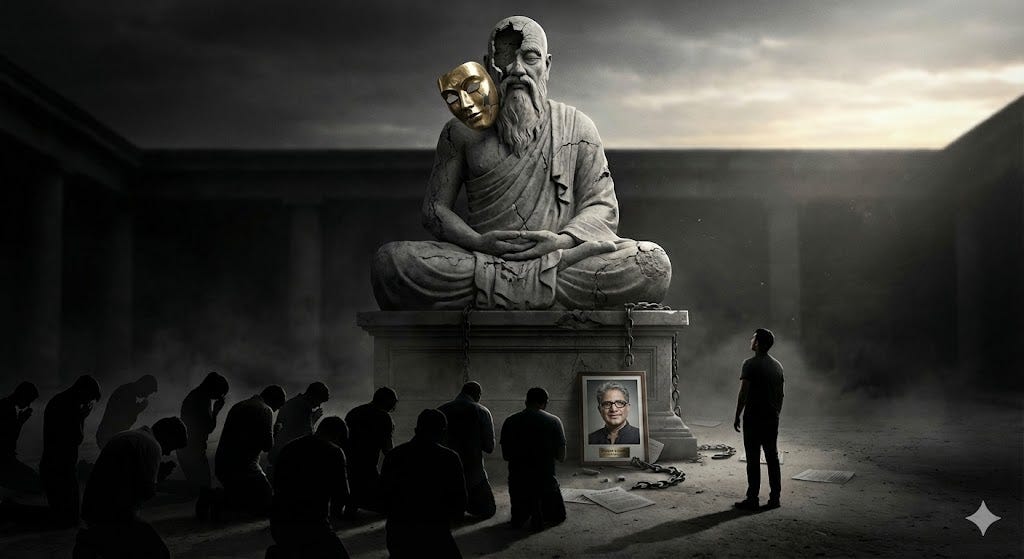
The Epstein files didn’t just expose one man. They unmasked an entire industry built on the performance of courage and the exploitation of our deepest wounds.
The Greek word apocalypse does not mean the end of the world. It means the stripping away of what was never real to begin with.
And what is being stripped away right now—through the Epstein files, through Deepak Chopra’s name appearing in them more than three thousand times, through the thunderous silence of an entire industry that built its fortune on the word courage—is not simply one man’s hypocrisy. It is the unmasking of a system in which we were all, in some measure, complicit.
Chopra’s name in those files is not a footnote. It is the body of the text. Overnight stays at the Palm Beach estate where the abuse happened. Hundreds of emails signed love and xoxo and all love, exchanged across years with a man who was already a convicted sex offender when they began. Business introductions, money brokered, royal families accessed, tech deals negotiated—all of it flowing through Jeffrey Epstein’s living room like water through a pipe.
And threaded through all of it, casual and constant: your girls, bring your girls, the girls would love it, send two girls. Epstein offered to send two young women to Chopra’s Wall Street speaking event. Chopra’s response: please send their names to me, I will put them on the guest list.
Not once in seven hundred pages does he ask who they are. Their ages. Whether they chose to be there.
That absence is not an oversight. It is the document’s most important sentence.
Millions of people brought something genuinely fragile to this man. People in grief, people unmade by loss, people who found in his words about consciousness and healing a floor to stand on when the ground had disappeared beneath them. That help was not fictional. Which is precisely why this betrayal has a particular anatomy. It requires trust, trust requires the exposure of what is most tender in us, and what is most tender in us, handed to the wrong person, becomes the instrument of the wound.
You cannot be truly betrayed by someone you never truly believed in.
The Performance of Courage
But the wound does not stop with Chopra. It spreads outward into the silence that has followed.
Tony Robbins. Brené Brown. Oprah Winfrey. Jay Shetty. Eckhart Tolle. Marianne Williamson. More than twenty names. More than 250 million followers between them. The Department of Justice files became public in January 2026. Not one of these people has said a word.
Meanwhile, a sixteen-year-old came forward on social media about her own encounter with Chopra at a meditation event—how he pressed his number into her hand, urged her to meet him late at night—and her post was seen by two million people before any of the industry’s architects acknowledged the conversation existed.
A teenager, alone, with more moral clarity than the entire apparatus of the modern wellness machine.
This silence is not caution. Lawyers advise caution; this is something else. This is the behavior of people who built careers telling others to be brave, discovering that bravery, in their own lives, had always been conditional. Every book about living your truth. Every podcast about doing the hard thing. Every retreat designed to crack you open and hand you back to yourself—all of it predicated on the quiet assumption that the hard thing would never actually cost the teacher anything.
When it did, they went quiet. Which means the product was always the performance of courage, not its practice.
The Illusion of the Untranscended Ego
This pattern is not new. Osho, Bikram Choudhury, John Friend—the history of spiritual celebrity is a history of charisma deployed as cover.
What the untranscended ego understands, intuitively, is that eloquence and esoteric vocabulary create an almost impenetrable shield. When a man speaks beautifully about consciousness, the listener’s discernment softens. The beauty of the language is mistaken for the purity of the man. It is one of the oldest and most effective deceptions available to human beings, and it works precisely because the longing it exploits is genuine.
We have to sit with that. Not just the failure of the men, but our own willingness to be charmed into surrender.
From childhood, many of us carry a wound shaped like an absent or unreliable authority—a father who disappeared or dominated, a world that offered punishment where it promised safety. That wound does not announce itself at the door of a wellness retreat. It enters with us, quiet and searching, and it recognizes the man onstage as something it has always been hungry for: a father who finally knows the answers, a god who will not abandon you if you are devoted enough.
This is the psychology that predatory systems have always known how to find. Epstein’s network did not survive his 2008 conviction through luck. It survived because power protects its own, and because the people in that network—Chopra among them—needed what he provided more than they needed to ask the questions that would have ended the arrangement.
Reclaiming the Sacred
We enable this every time we mistake polish for character. Every time we hand our inner authority to someone because they are famous, articulate, and impressively groomed.
The divine—whatever that word means to you—does not live in a bestseller or a sold-out arena. It is not brokered by celebrities and it cannot be purchased through premium access. The entire foundation of any serious spiritual tradition, across every culture and century, is that the sacred is not outside you. The moment you outsource that knowing to another human being, you have made yourself available to be exploited by whoever understands that hunger best.
Take the ancient wisdom that helped you. It belongs to no one—certainly not to Deepak Chopra, who drew from traditions that predate him by several thousand years and will outlast this scandal by several thousand more. Keep the breathwork, the meditation, whatever moved through you and opened something real. Sever the man from the message completely and without sentimentality. He is not the tradition. He is what happened to it in one particular pair of hands.
But more than discarding him—discard the architecture of devotion that made him possible.
The veil is lifting. What is underneath it is not the apocalypse.
It is the invitation to finally stop kneeling.
Blessings.
Afshine Ash Emrani, M.D., F.A.C.C.
Assistant Clinical Professor, UCLA
David Geffen School of Medicine
Castle-Connolly Nationwide Top Doctor (Since 2008)
Los Angeles Magazine Super Doctor (Since 2010)
LA Style Magazine Top 100 Doctors in America (2024)
I have been enjoying your posts on FB for a very long time now. I am delighted to see you are in the substack space as well. I look forward to reading many more of your very insightful and extremely well written posts here.