

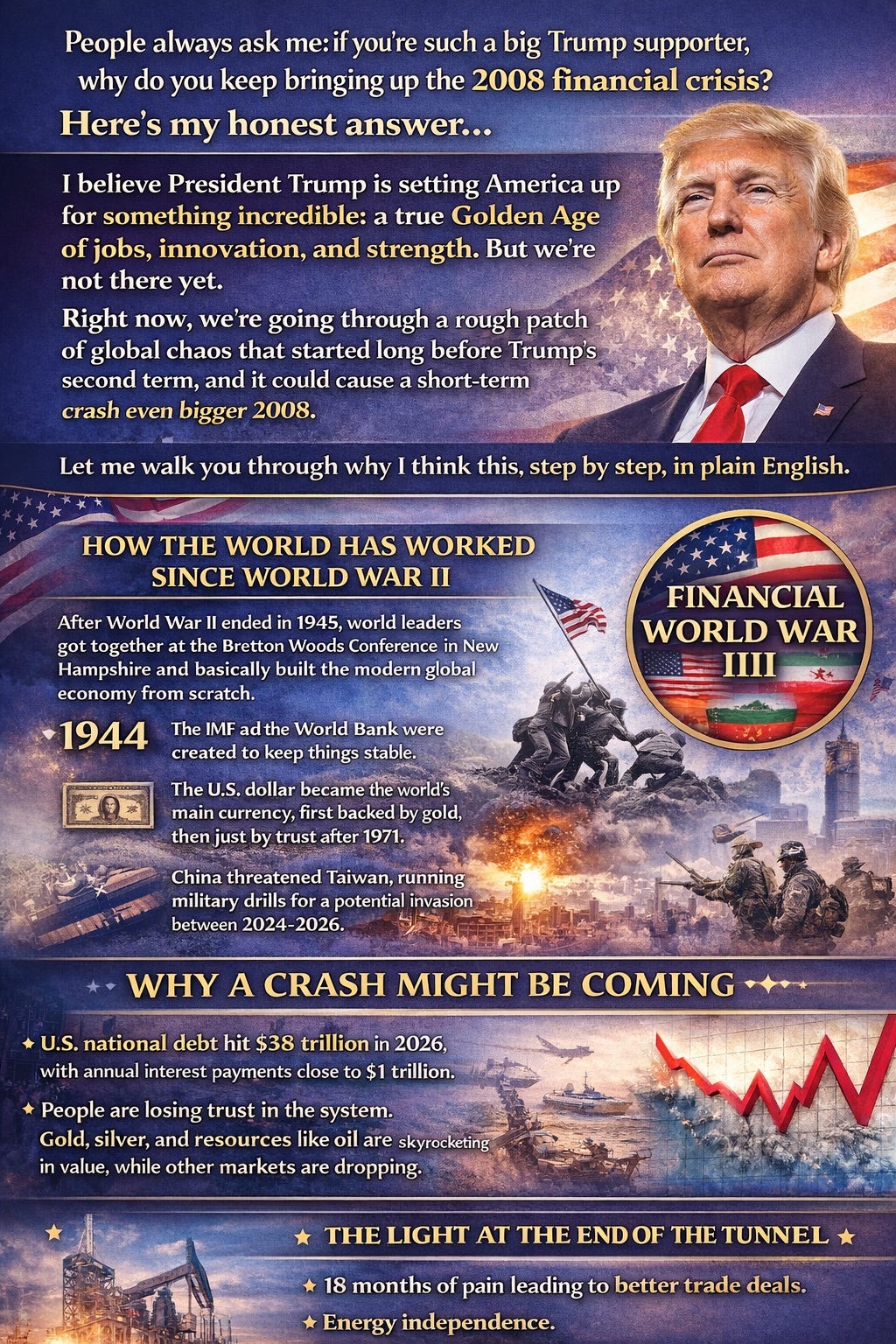
People always ask me: if you’re such a big Trump supporter, why do you keep bringing up the 2008 financial crisis? Here’s my honest answer. I believe President Trump is setting America up for something incredible — a true Golden Age of jobs, innovation, and strength. But we’re not there yet. Right now, we’re going through a rough patch of global chaos that started long before Trump’s second term, and it could cause a short-term crash even bigger than 2008. Let me walk you through why I think this, step by step, in plain English.
How the World Has Worked Since World War II
After World War II ended in 1945, world leaders got together at the Bretton Woods Conference in New Hampshire and basically built the modern global economy from scratch. They created big institutions like the International Monetary Fund (IMF) and the World Bank to keep things stable. The U.S. dollar became the world’s main currency — first backed by gold, then just by trust after 1971.
Countries started specializing in what they were good at. China became the world’s factory, pumping out cheap products. America focused on tech, innovation, and buying stuff. Japan became a major global lender. Europe rebuilt itself with American aid through the Marshall Plan. This system — call it “globalism” — pulled billions of people out of poverty. But it also made everyone dependent on each other. America got hooked on cheap imports, and the dollar’s power was tied to oil trades (that’s where the term “petrodollars” comes from).
For a long time, this setup worked pretty well. But problems built up quietly. The U.S. started running massive trade deficits, meaning we were buying way more from other countries than we were selling to them. Jobs went overseas. Meanwhile, countries like China got rich while breaking the rules — stealing American technology, messing with their currency to keep exports cheap, and ignoring environmental standards.
How Things Started Falling Apart
Under President Biden, the cracks in this global system turned into full-blown disasters.
Russia invaded Ukraine in February 2022. A lot of people blame this on weak U.S. leadership — Biden’s team didn’t do enough to scare Putin off, though Putin is obviously the one who pulled the trigger. This invasion caused energy prices to explode in Europe and sent inflation skyrocketing around the world.
Hamas attacked Israel on October 7, 2023, killing over 1,200 people and taking hostages. Iran funded and armed Hamas, though Iran didn’t directly plan the attack.
China threatened Taiwan, running military drills and making aggressive statements suggesting they might invade between 2024 and 2026.
These aren’t random, disconnected events. They’re all part of what I call a new “Financial World War III” that really started with COVID-19 in 2020. Think of it like two teams: America is backing Ukraine against Russia, while China is supporting Iran, Hamas, and Hezbollah. In response to Russia’s invasion, the U.S. and its allies kicked some Russian banks off SWIFT (the system banks use to send money internationally) in 2022. That basically cut Russia off from the global financial system.
This scared the BRICS nations — Brazil, Russia, India, China, and South Africa. They started pushing to move away from the U.S. dollar (”de-dollarization”), doing more trade in their own currencies like the Chinese yuan or the Indian rupee. It’s mostly small-scale deals between individual countries so far, and the dollar is still king, but the trend is real and growing since 2024.
Borders feel less stable. Countries aren’t cooperating like they used to. Global institutions like the United Nations and the World Trade Organization seem helpless.
The “Fourth Turning” — History Repeating Itself
This all lines up with something called the “Fourth Turning” theory, from historians William Strauss and Neil Howe. Their idea is simple: history repeats in roughly 80- to 100-year cycles with four phases — a High (good times and growth), an Awakening (cultural change), an Unraveling (division and distrust), and a Crisis (major upheaval that reshapes everything). We’re in the Crisis phase right now, which started around 2008, with economic crashes, wars, and failing institutions. The last Crisis phase? The Great Depression and World War II. Big stuff.
What Trump Is Doing: Blowing Up the Old System
Trump won re-election in 2024 on his “America First” platform, and he’s not playing nice with the old rules. He’s the disruptor. At the World Economic Forum in Davos in January 2026, he flat-out declared globalism dead. He called the green energy movement a “scam,” trashed windmills, and pushed hard for fossil fuels. His message was clear: every country is on its own now. No more free rides for anyone.
Here’s what he’s actually doing:
Tariffs to Bring Jobs Home
He started with a 10% tariff on basically everything in 2025, then cranked it up to 20-30% on Chinese goods, plus 25% on imports from Canada and Mexico. The goal? Force companies to build factories here in America instead of shipping jobs overseas. No more printing trillions of dollars to bail out Wall Street banks like we did in 2008 — instead, we get real jobs from real production and energy dominance.
Changing the Federal Reserve
Trump picked Kevin Warsh as the new Fed Chair in 2026, which signals he wants tighter control over money policy. There’s even talk that the Treasury Department could take over some of the Fed’s power.
Aggressive Foreign Policy
Trump isn’t just talking tough — he’s acting. Sanctions and military strikes on Venezuela led to Maduro’s capture in 2026. He’s pressuring Iran, including strikes on nuclear sites. He’s shown interest in buying Greenland for strategic purposes and has made threats toward Cuba. By controlling oil-rich nations and key resources, Trump forces China and Russia to come to the table and negotiate with “Daddy Trump” for what they need. This could either prevent or provoke bigger conflicts, like a Chinese invasion of Taiwan.
Why a Crash Might Be Coming
Here’s the scary part. The world is drowning in debt.
The U.S. national debt hit $38 trillion in 2026. Just the interest payments on that debt are close to $1 trillion a year — that’s more than we spend on the entire military. The previous Fed Chair, Jerome Powell, kept interest rates high for too long (around 4-5% in 2025), which made all that debt way more expensive to carry.
You can see people getting nervous. Gold prices shot up past $5,000 and silver past $100 between 2024 and 2026. Meanwhile, Bitcoin dropped 30% from its 2025 highs. People are dumping newer, riskier investments like crypto (which has only been around for 14 years) and running to things that have been valuable for thousands of years, like gold and silver.
We’d need somewhere between $20 to $30 trillion to fill the financial hole, but Trump isn’t going to print that money. There won’t be a 2008-style bailout. That means we could see a crash in 2026 that makes 2008 look mild: stocks dropping 50-90%, housing bubbles popping, and supply chains going haywire because of the tariffs. Some experts warn there’s a 10-20% chance of a full-blown global crisis, made worse by excessive debt and AI-driven financial speculation.
What I’ve Been Warning About — and What Finally Broke
For the past year, I’ve been telling anyone who would listen that I see a 2008-style crash coming. I could feel it in my gut — something was going to break. I didn’t know what it would be or how it would happen. Some people told me it would be the credit markets that would blow up first. Others said it would be the bond market. Everyone had a theory, but nobody could point to the exact thing.
I think I’ve finally figured it out. What broke is TRUST.
Think about it. Globalism wasn’t just a trade system — it was a trust system. Every country agreed to play by certain rules, respect certain borders, and rely on each other. The dollar was trusted as the world’s currency. Banks were trusted to settle payments through SWIFT. Countries were trusted to honor their debts and trade deals. The whole thing ran on trust between nations.
That trust is now shattered. Russia broke the trust when it invaded Ukraine. The West broke trust with Russia when it weaponized SWIFT and froze assets. China broke trust by threatening Taiwan and stealing technology. The U.S. broke trust with its allies by going “America First” and slapping tariffs on everyone. Every link in the chain is cracking because nobody trusts anybody anymore.
And here’s where it gets really interesting. I believe Bitcoin was a social contract — a digital agreement built on the idea that people could trust a decentralized system instead of governments and banks. But those contracts are breaking too. Bitcoin is leading the decline, and in my opinion, it’s the canary in the coal mine. It’s sniffing out something much larger. When the asset that was supposed to be the ultimate “trustless” system starts crumbling, that tells you the problem isn’t just one market or one country — it’s the very foundation of how the global system holds together. Trust itself is what broke, and everything else will follow.
The Light at the End of the Tunnel
I know this sounds rough. And it will be rough — probably 18 months of real pain. Prices will go up because of tariffs. Jobs will shift around as manufacturing comes back to America. The stock market will be a rollercoaster.
But after that? Real growth. New factories opening on American soil. Energy independence. Better trade deals where we’re not getting ripped off. America competing with China by controlling resources and leading in innovation.
This isn’t a doom-and-gloom prediction. It’s a reset. Trump is shaking the old, broken system to build something stronger and better. If we can get through the storm, the Golden Age is waiting on the other side. But if we ignore the risks and pretend everything is fine, 2026 could make the 2008 crash look like a bad day at the office.
Afshine Ash Emrani, M.D., F.A.C.C.
Assistant Clinical Professor, UCLA
David Geffen School of Medicine
Castle-Connolly Nationwide Top Doctor (Since 2008)
Los Angeles Magazine Super Doctor (Since 2010)
LA Style Magazine Top 100 Doctors in America (2024)
Subscribe to mynewsletter: substack.com/@afshineemrani
Explore my books: Amazon Author Profile