

The Universe Is Not Against You
We are living through a time of extraordinary anxiety. Wars rage across continents. Political divisions feel insurmountable. Economic uncertainty looms. Social media feeds us a steady diet of catastrophe. And somewhere in the back of our minds, many of us carry an unspoken fear: maybe the world really is falling apart. Maybe things really are as bad as they seem.
Into this moment comes a question that Albert Einstein reportedly posed—one that cuts beneath politics, beneath ideology, beneath all the noise: Do you believe you live in a friendly universe or a hostile one?
This is not a philosophical abstraction. It is the most practical question you will ever answer. Because the way you answer it shapes everything—your decisions, your relationships, your mental health, the way you interpret every event in your life. Two people can witness the exact same tragedy, the exact same triumph, the exact same ambiguous moment, and walk away with entirely different understandings of what it means. The difference lies not in what happened, but in the fundamental story they believe about reality.
What Pharaoh Saw
This week’s Torah portion, Parashat Bo, contains a strange and illuminating exchange. Moses has warned Pharaoh about the coming plague of locusts. Egypt is about to be devastated. And in the midst of this confrontation, Pharaoh says something cryptic to the Israelites:
“Beware, for evil faces you.”
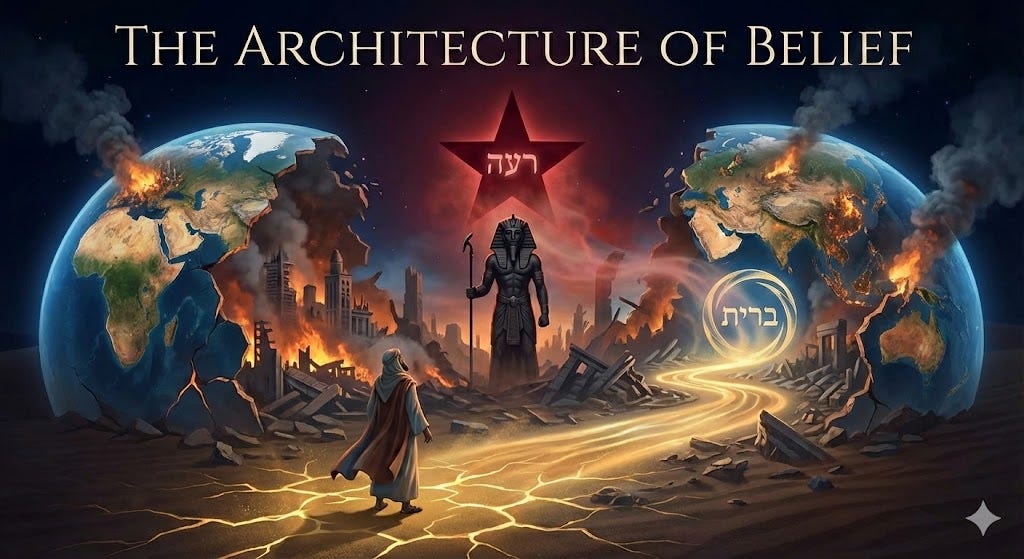
The Midrash explains that Pharaoh wasn’t just issuing a vague threat. He was an astrologer, and he had seen something in the stars—specifically, a star called Ra’ah, which means “Evil.” Through his calculations, Pharaoh perceived that if the Jews left Egypt, they would encounter “blood” in the desert. He interpreted this as a prophecy of doom: God would turn against His people. There would be mass death. The exodus would end in catastrophe.
Pharaoh looked at the cosmic signs and saw destruction. He saw a hostile universe. He saw a God eager to punish.
But here’s where the story takes a turn. Years later, after the sin of the Golden Calf, when the Israelites indeed faced the possibility of Divine punishment, Moses reminded God of Pharaoh’s prophecy. The blood in the desert—it seemed to be coming true.
And what did God do? He transformed the meaning of the blood entirely. The “blood” that Pharaoh saw as a symbol of death became the blood of brit milah—circumcision—performed under Joshua’s leadership. The same omen that Pharaoh read as evidence of Divine wrath became a symbol of eternal covenant. Of love. Of unbreakable commitment.
The sign didn’t change. The interpretation did.
The Pharaoh Within
Here is the uncomfortable truth: many of us go through life with Pharaoh’s eyes.
We see difficulty and assume it’s punishment. We experience setback and conclude that God—or the universe, or fate, or whatever we call the forces beyond our control—is against us. We interpret our struggles as evidence of rejection. We carry around a mental image of the Divine as a harsh judge with a clipboard, marking down our failures, eager to catch us in our mistakes.
Where does this come from? Sometimes from anxious temperaments we were born with. Sometimes from teachers who taught us to see religion as a system of fear rather than love. Sometimes from the ambient influence of cultural narratives that frame life as a punishment to be endured rather than a mission to be embraced. Sometimes from our own guilt, which we project onto the cosmos itself.
Whatever the source, this belief in a hostile universe creates a devastating feedback loop. The more we believe God is against us, the more distant we feel from any real spiritual connection. The more distant we feel, the more evidence we find for our belief. And the suffering we already experience from life’s genuine difficulties gets compounded by the additional suffering of believing we deserve it—that we are unloved, unforgiven, fundamentally rejected.
This is a prison of perspective. And the door is unlocked from the inside.
The Radical Claim
Judaism makes a claim that, if we actually believed it, would change everything: God is not against you. God has never been against you. God will never be against you.
This is not naive optimism. It does not mean that life is easy, that suffering is an illusion, or that everything happens for obvious reasons we can understand. The tradition is honest about darkness. There are periods in every human life when God’s love is almost impossible to feel—when the stars are too hazy to read, when the pain is too acute for theology to touch. Judaism has room for that. Some questions don’t have answers. Some grief doesn’t resolve.
But beneath the unanswerable questions, beneath the periods of haze and confusion, Judaism insists on a foundational truth: the universe is not hostile. The Talmud makes the radical statement that when we suffer, God suffers alongside us. Not above us, judging. Beside us, present. The Divine is not a distant critic. The Divine is closer than we can imagine.
And even the most ominous signs—the blood-red omens that seem to spell doom—can be transformed. Not because we pretend they aren’t there, but because their meaning is not fixed. What looks like an ending can become a beginning. What looks like punishment can become initiation. What looks like rejection can become deeper covenant.
Here is what I want you to consider: God knows exactly what He is asking of you.
He knows that He has placed your soul in the lowest of spiritual realms—a world that conceals His presence, a world full of pain and disappointment and instability. He knows that your opponents, both internal and external, are formidable. He knows how hard it is to choose goodness when you are exhausted, overwhelmed, afraid. He knows how difficult it is to maintain faith when the news is relentless and the future is uncertain.
He knows—and He still believes in you.
Not because He expects perfection. No one scores 100% on the exam of life. But because in the very attempt to try, in the very act of choosing goodness despite difficulty, you accomplish something that no other being in any dimension of creation can accomplish. You bring light into darkness. You sanctify the ordinary. You matter.
The world right now feels heavy. The signs seem ominous. It’s easy to slip into Pharaoh’s mindset—to read everything as evidence that something terrible is coming, that we are being abandoned, that the universe has turned its back.
But you have a choice about how to read the signs. And the choice you make will shape the life you live.
The next time you catch yourself interpreting events as proof of cosmic hostility—God is punishing me, the world is falling apart, everything is getting worse—pause. Notice the interpretation. And then ask yourself: Is there another way to read this?
Not a dishonest way. Not a way that denies real suffering or pretends problems don’t exist. But a way that doesn’t add the extra layer of believing you are unloved. A way that remembers you are not alone. A way that transforms the blood from a symbol of death into a symbol of covenant.
This is not about toxic positivity. It’s about refusing to let Pharaoh’s worldview colonize your mind.
The universe is not hostile. You are not abandoned. The difficulties you face are not proof of rejection—they are the terrain of your particular mission, the specific arena in which your soul was sent to bring light.
God is rooting for you. Even now. Especially now.
And when we remember that, the blood of destruction becomes the blood of love.
If this piece resonated with you, please share it with someone who might need to hear it.
Afshine Ash Emrani, M.D., F.A.C.C.
Assistant Clinical Professor, UCLA
David Geffen School of Medicine
Castle-Connolly Nationwide Top Doctor (Since 2008)
Los Angeles Magazine Super Doctor (Since 2010)
LA Style Magazine Top 100 Doctors in America (2024)
Subscribe to mynewsletter: substack.com/@afshineemrani
Explore my books: Amazon Author Profile