

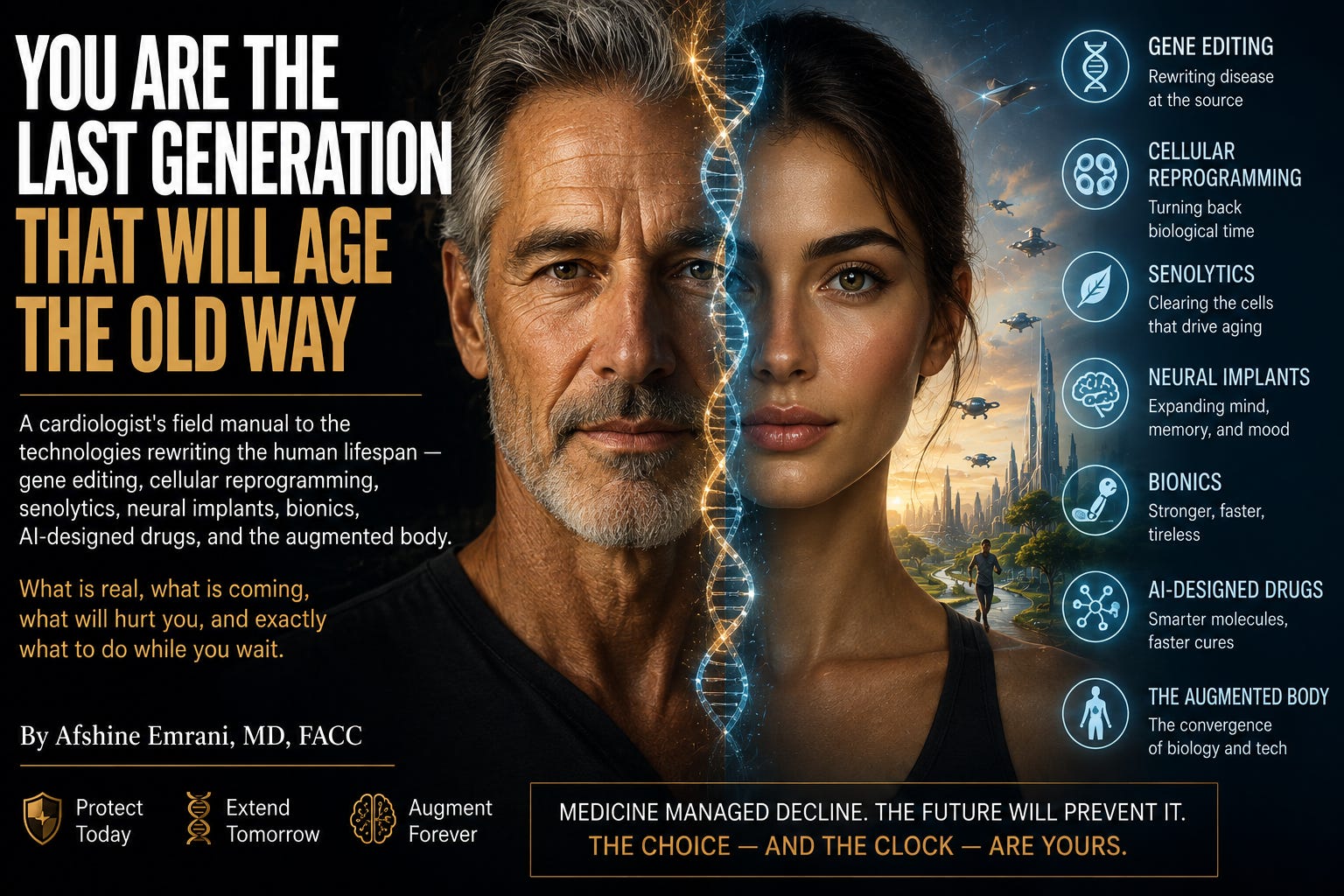
You Are the Last Generation That Will Age the Old Way
A cardiologist’s field manual to the technologies rewriting the human lifespan — gene editing, cellular reprogramming, senolytics, neural implants, bionics, AI-designed drugs, and the augmented body. What is real, what is coming, what will hurt you, and exactly what to do while you wait.
By Afshine Emrani, MD, FACC
I have spent more than twenty years with my hands on the human heart, and for most of that time I practiced a kind of medicine a physician from 1975 would recognize instantly.
We waited for damage. We measured it. We slowed it down. We managed decline with skill and dignity, and when the decline finished its work, we told families we had done everything we could — and we usually had.
That era is ending. I do not think most people understand how completely.
In the last twenty-four months I have watched an enzyme built by directed evolution strip seventy percent of the molecular scarring off a seventy-five-year-old human aorta — damage we called permanent for forty years. I have watched a gene therapy designed for one specific infant, manufactured in months, cure a disease that had no treatment and never would have justified a development budget. I have watched a quadriplegic man play chess with his thoughts. I have watched twelve people with type 1 diabetes receive an infusion of lab-grown islet cells, and ten of them walk out insulin-free.
And in June of this year, a patient somewhere received an injection into one eye carrying genes that reset the epigenetic clock of the cells inside it. The first deliberate attempt in human history to make a living tissue biologically younger.
None of this is science fiction. All of it happened while most of medicine was doing paperwork.
Here is the claim I want to make, and I want to be held to it: the person reading this may belong to the last cohort that experiences aging the way every human before us did — as a one-directional process we could only decorate with better management.
Not because immortality is arriving. It isn’t, and anyone selling you that is lying. But because for the first time we possess tools that go backward rather than merely slowing forward, and they are moving out of the laboratory at a pace the medical establishment has not remotely internalized.
The people who benefit most will not be the ones with the best supplement stack. They will be the ones who understood what was coming, kept their biology intact long enough to receive it, and knew how to tell the real from the sold.
This manual is my attempt to map that landscape honestly — the biology, the machines, the timelines, the traps, and the protocol you execute today so that you are still here, and still worth treating, when the rest of it arrives.
But before any of it, the single idea that organizes everything else.
PART ONE: THE IDEA THAT CHANGES THE FRAME
Aging is not damage. Aging is lost information.
For a century we assumed aging was accumulated wear — a machine grinding down, parts failing, entropy winning. If that were the whole story, aging would be essentially irreversible. You cannot un-rust a bridge.
But there is a more powerful framing, and the evidence increasingly supports it.
Consider that every cell in your body contains an identical genome. A neuron and a liver cell carry the same three billion letters. What makes them different is not their DNA — it is which genes they read. That reading is governed by the epigenome: chemical marks on the DNA and the proteins around it that tell each cell which parts of the manual to open.
Aging, in this framework, is the progressive corruption of that reading system. Your cells still possess the information. They increasingly cannot find it. Methylation patterns drift. Chromatin organization degrades. A liver cell at eighty is still a liver cell, but a slightly confused one, expressing genes it should have silenced and silencing genes it should express.
The analogy I use with patients: a scratched compact disc. The music is still encoded on the disc. The laser can no longer track it cleanly. You do not need to rerecord the album. You need to polish the surface.
This distinction is not academic. It is the difference between a condition we can only slow and a condition we might genuinely reverse.
And it explains why the same technologies keep appearing across unrelated diseases. If lost epigenetic information is upstream of heart failure, dementia, frailty, and cancer, then restoring it is not one treatment for one disease. It is a lever on the process that produces all of them.
The second idea: your body is engineerable
The mindset shift that follows is uncomfortable for some physicians and liberating for patients.
We have historically treated the body as something that happens to you. Increasingly it behaves like a system that can be read, measured, debugged, and modified — with feedback loops, failure modes, and specifications.
That does not make you a machine. It makes you a system with a control panel we are finally learning to read.
And the practical consequence is this: the most important skill in the coming era of medicine will not be knowing which therapy to take. It will be knowing your own numbers well enough to tell whether anything is working.
PART TWO: READING THE BODY
Everything downstream depends on measurement. You cannot debug a system you cannot observe.
Biological age versus the number on your license
Chronological age is a bookkeeping fact. Biological age is a physiological one, and they diverge enormously.
Epigenetic clocks read methylation patterns at specific genomic sites and estimate biological age. The first generation simply predicted chronological age accurately. The more useful modern versions — the phenotypic and mortality-predicting clocks, and pace-of-aging measures — estimate not just how old you are but how fast you are currently aging.
That second measurement is the one that matters, because it responds to what you do.
A 2026 analysis of over 164,000 people found that those born in the 1990s show a biological age gap roughly 92% larger than those born in the 1960s. Same chronological age, meaningfully older biology. And the fastest agers carried up to 15% higher risk of developing cancer before fifty-five.
Start free. PhenoAge is calculated from nine markers most people already have: albumin, creatinine, glucose, CRP, lymphocyte percentage, MCV, RDW, alkaline phosphatase, and white blood cell count. A basic metabolic panel, a CBC, and a CRP. Free calculators exist.
Then, if you want depth: commercial epigenetic clocks run roughly $200-500. A caution that the industry rarely mentions — these tests have meaningful test-retest variability. A single measurement is noisy. Trend them; do not react to one number.
Organ-specific aging
The frontier here is genuinely exciting. Your organs do not age at the same rate, and proteomic and methylation-based organ clocks can increasingly tell you which system is failing fastest.
Your liver behaving like a sixty-one-year-old’s while your calendar says fifty-two. Your kidneys tracking beautifully. Your vascular system drifting.
For a cardiologist, an early molecular signal of arterial aging would be transformative. We measure ApoB, Lp(a), and hs-CRP — all excellent, all indirect. We image plaque — but plaque is visible only after decades of silent disease. A molecular signal would let us act during the window when the process is still fully reversible.
Mitochondrial function: the energy layer
Mitochondria are not merely power plants. They are signaling hubs that influence inflammation, cell death decisions, and gene expression. Mitochondrial decline is a hallmark of aging and appears upstream of fatigue, insulin resistance, muscle loss, and cognitive decline.
What actually improves mitochondrial function, in descending order of evidence:
Zone 2 endurance training — the single most powerful mitochondrial intervention known. It increases mitochondrial density and improves the efficiency of fat oxidation. No compound competes with it.
Resistance training. Adequate sleep. Metabolic health — insulin resistance impairs mitochondrial function directly.
Then, at a lower evidence tier: NAD+ precursors and urolithin A, which promotes mitophagy — the recycling of damaged mitochondria. Both have human biomarker data. Neither has outcome data.
The panel that actually predicts your future
Metabolic: fasting insulin (under 5), HOMA-IR (under 1.0), HbA1c (under 5.4%), triglyceride:HDL ratio (under 2)
Cardiovascular: ApoB (under 80, under 60 with disease), Lp(a) once in your lifetime, hs-CRP (under 1.0), homocysteine
Hormonal: full thyroid with free T3 and antibodies; complete sex hormone panel with SHBG and free fractions
Nutrient: vitamin D (50-80), B12 with methylmalonic acid, ferritin read alongside hs-CRP, RBC magnesium, omega-3 index
Organ: cystatin C, urine albumin-to-creatinine ratio, ALT, AST, GGT
Functional: VO2 max, grip strength, gait speed, DEXA body composition, home blood pressure
The principle: one panel is a data point. Three is a trend. Direction beats position. Export everything into one spreadsheet and plot the slope.
PART THREE: THE REPAIR TOOLKIT
These technologies share a common ambition: not to slow damage, but to clear or reverse what has already accumulated.
Senolytics: killing the cells that refuse to die
Senescent cells stop dividing but resist apoptosis. They accumulate with age and secrete a continuous stream of inflammatory signals — the senescence-associated secretory phenotype — that damages neighboring tissue and spreads dysfunction outward.
The finding that launched the field is startling: transplanting even a small number of senescent cells into a young mouse causes persistent physical dysfunction and shortens lifespan. These are not inert debris. They are actively toxic.
The mechanism is elegant. Senescent cells depend on specific survival pathways to avoid dying. Disable those pathways briefly and the cells self-destruct. This permits “hit and run” dosing — two or three days, then weeks off — which dramatically limits toxicity compared to continuous exposure.
The animal data: in the landmark Mayo Clinic study, intermittent dasatinib plus quercetin in naturally aged mice increased post-treatment survival by 36% while improving walking speed, endurance, and grip strength. Subsequent work has shown systemic rejuvenation of the aging kidney.
The human data is early. Small open-label studies in idiopathic pulmonary fibrosis showed improved physical function. A diabetic kidney disease study demonstrated genuine reduction in senescent cell burden in human tissue — real proof of mechanism. Trials are running in Alzheimer’s disease, frailty, and osteoarthritis.
Now my obligation as a physician. Dasatinib is a leukemia chemotherapy drug. It carries real toxicity — cytopenias, fluid retention, pleural effusion, bleeding risk, cardiac effects, and substantial drug interactions. People are currently buying it from gray-market sources and dosing themselves from internet protocols. That is genuinely dangerous, and one liver cancer model even showed unexpected pro-tumorigenic effects.
Fisetin is the accessible alternative — a natural flavonoid with a far better safety profile, studied at roughly 20 mg/kg for two to three consecutive days monthly. Human efficacy data remains thin and absorption is poor without fat or a liposomal formulation.
My position: compelling science, genuinely early. If you want access, pursue a clinical trial where you receive monitoring and contribute to real knowledge.
NAD+ precursors
NAD+ is a coenzyme essential to energy production and to the function of sirtuins and DNA repair enzymes. Levels decline substantially with age, and that decline plausibly contributes to mitochondrial dysfunction and impaired repair.
Precursors — nicotinamide riboside and nicotinamide mononucleotide — reliably raise blood NAD+ levels in humans. That much is established.
What is not established is whether raising blood NAD+ produces meaningful clinical benefit. Human trials have shown mixed results: some improvements in specific biomarkers, inconsistent effects on physical function, and no outcome data. Tissue-level delivery remains an open question — raising the level in blood is not the same as raising it inside a neuron.
There is also a theoretical caution worth naming: NAD+ supports growth and repair pathways broadly, and whether that is uniformly desirable in a person harboring undetected malignancy is not fully characterized.
Honest assessment: biologically plausible, safe at studied doses, insufficient evidence for confident recommendation. Exercise raises NAD+ too, and it has outcome data.
Rapamycin
The most robustly validated lifespan-extending compound in animal models. It inhibits mTOR — the nutrient-sensing pathway that governs growth versus repair — and it extends lifespan in yeast, worms, flies, and mice, including when started in late life.
The mechanism connects to something you already control: mTOR is also modulated by protein intake and fasting. Rapamycin is pharmacologically doing a version of what caloric and protein restriction do metabolically.
Human longevity data does not exist. Intermittent low-dose protocols are used off-label by some physicians, and preliminary safety data in healthy adults exists. Risks include immunosuppression, impaired wound healing, mouth ulcers, and metabolic effects including glucose intolerance at higher or continuous dosing.
This requires physician supervision. It is not a supplement.
Peptides
Peptides are short amino acid chains — fragments of the same signaling language your body already speaks. Insulin is a peptide. So is the GLP-1 in the drugs transforming metabolic medicine.
That is exactly what makes them seductive and exactly what makes them risky. They are signaling molecules. They flip switches. And a molecule potent enough to accelerate tissue repair is, almost by definition, potent enough to accelerate things you do not want growing.
The regulatory landscape is shifting. In July 2026 an FDA advisory committee voted to recommend adding BPC-157 to the list of substances licensed compounding pharmacies may prepare. The vote was 8-6, over the objection of FDA’s own scientific staff, and it remains advisory and non-binding — formal rulemaking takes twelve to twenty-four months.
The honest state of evidence: the strongest published human data for BPC-157 involves roughly thirty subjects, with the longest treatment lasting about two weeks — and the routes studied barely overlap with how people actually use it. TB-500 has no completed human randomized trials. The others range from thin to nearly empty.
And the supply chain should alarm you. Over forty percent of gray-market samples fail purity testing. People are buying research-grade powder from anonymous overseas sellers and reconstituting it on kitchen counters with bootleg sterile water.
Where I land: a regulated pathway through licensed pharmacies would be a genuine safety improvement over the status quo, and I support that. But access without evidence is not liberation. It is a better-looking gamble. My specific concern as a cardiologist: BPC-157 works partly through angiogenesis. Before you inject a molecule whose job is to say grow, you should have reasonable confidence about what is already growing inside you.
Cellular reprogramming: the deepest reset
This is, in my view, the most important idea in aging biology, and it follows directly from the information framing.
Four genes — the Yamanaka factors — can reset an adult cell all the way back to pluripotency, erasing its identity entirely. That is too far; it produces teratomas. But partial reprogramming, using a subset of those factors applied transiently, appears to restore youthful epigenetic patterns while preserving what the cell is.
In animals, this has restored vision after optic nerve injury and in aged mice, improved tissue function, and extended remaining lifespan.
It is now in humans. The first-in-human partial reprogramming therapy uses an AAV vector to deliver reprogramming genes by a single injection into one eye, with a doxycycline-inducible switch — oral doxycycline activates expression for roughly eight weeks, then it shuts off. Controlled, time-limited exposure.
The Phase 1 trial targets glaucoma and ischemic optic neuropathy. FDA clearance came in January 2026; the first patient was dosed in June 2026. Approximately eighteen participants, dose escalation, follow-up up to five years.
Why the eye first: localized delivery limits systemic exposure, the eye is immune-privileged, AAV vectors are established in ophthalmology, and visual function can be measured precisely without invasive procedures.
The open questions are serious. Optimal duration and intensity of expression. Durability of the reset. And cancer risk in systemic applications — reprogramming and oncogenesis share biology, and that is not a trivial concern.
Safety readouts expected late 2026 into 2027. This is the single most important clinical readout in the entire longevity field, and almost nobody outside the field is watching for it.
Enzymatic reversal of accumulated damage
Some proteins in your body are laid down early and essentially never recycled — collagen, elastin, the crystallins in your eye lens. They are permanent scaffolding, and everything that happens to them over seventy years stays.
Sugar reacts with those proteins the way heat browns bread, leaving advanced glycation end-products that stiffen arteries, cloud lenses, and drive inflammation through the RAGE receptor. Since the 1980s this was considered irreversible.
Researchers screened forty-five thousand protein structures and ran five rounds of directed evolution across more than five hundred million variants to build an enzyme that does not exist in nature — one that strips this damage off proteins and restores the healthy amino acid underneath.
Applied to the aorta of a seventy-five-year-old donor, it removed over seventy percent of the damage, down to levels seen in a thirty-year-old artery.
Caveats: ex vivo tissue, not a living person. No functional data yet on elasticity. Delivering a large enzyme deep into tissue is unsolved.
Why I care: arterial stiffness drives systolic hypertension, heart failure, and stroke, and I have no drug that reverses it. This is the first credible claim that reversal may be possible.
PART FOUR: THE REBUILD TOOLKIT
Where the previous section clears and restores, this section replaces and rewrites.
Gene editing: from reading to writing
We spent the first genomic era learning to read. We are now learning to write.
Base editing and prime editing allow single-letter changes without cutting both DNA strands, dramatically reducing the risk of unintended rearrangements. This is the difference between a scalpel and a search-and-replace function.
The proof that changed everything: a bespoke gene-editing therapy was designed, manufactured, and delivered for a single infant with a fatal metabolic disorder — in months, not years. One patient. One custom therapy. That shatters the economic model medicine has always operated under, where a treatment must serve thousands to justify development.
In my own field: a single infusion of a base editor targeting PCSK9 has produced durable, substantial LDL reduction in early human trials. Not a daily pill. Not a monthly injection. One treatment, potentially permanent.
The open questions: durability across decades, off-target effects we have not yet detected, delivery to tissues beyond the liver, immune responses to the editing machinery, and the profound question of germline versus somatic editing — changing you versus changing your descendants.
Cell therapy: installing the factory
The distinction between peptides and cell therapy is the distinction between renting and owning.
Inject a peptide and it works brilliantly, then degrades, and you inject again. Install engineered cells and they sense what your body needs and produce it continuously, at physiological levels, responding to real signals.
The proof: stem-cell-derived islet cells infused into twelve people with type 1 diabetes. Ten were completely insulin-independent at one year, with a 92% mean reduction in insulin use. Published in the New England Journal of Medicine.
And the scalability breakthrough: hypoimmune engineering — gene-editing cells to evade immune detection — has allowed transplanted islet cells to survive and function in a patient taking zero immunosuppression. That solves the problem that has limited cell therapy for decades.
In cardiology: engineered regulatory T cells targeting oxidized LDL prevented over seventy percent of plaque buildup in animal models while preserving normal immune function. Not a statin lowering fuel — a living cell extinguishing the fire.
AI drug discovery
This is the accelerant beneath everything else.
Protein structure prediction solved a problem that consumed careers. Generative models now design binding pockets and novel proteins from scratch. The enzyme that stripped glycation from that aorta was found by screening forty-five thousand structures and five hundred million variants — that is not a wet-lab problem anymore, it is a compute problem.
AI research platforms now compress weeks of analysis into a single conversation, and major pharmaceutical companies have deployed them across tens of thousands of employees.
Why this matters more than it appears: protein design has become a search over an enormous space, and search problems get radically better with more compute and better models. Damage-repair medicine may begin to scale the way software scales.
And the economic consequence could be the most important part. If AI collapses the cost and time of discovery, the math that has left millions of rare-disease patients with no treatment gets rewritten. Diseases that were never worth a billion-dollar development budget become tractable.
Open-source biology and patient-driven medicine
Something genuinely new is happening at the edges.
A technology founder with terminal-stage cancer, told there was nothing left to try, generated twenty-five terabytes of his own molecular data — whole genome, transcriptomics, single-cell analysis, imaging, organoids grown from his own tumor. He fed it to AI as a research partner. He filed five individual-patient investigational applications with the FDA, all approved within forty-eight hours. He assembled a combination therapy from targeted radiation, checkpoint inhibition, a personalized neoantigen vaccine, and an oncolytic virus.
T-cell infiltration in his tumor went from nineteen percent to eighty-nine percent. The tumor shrank enough for surgery. He has had no evidence of disease since.
Then he published everything — the entire dataset, free and open — so anyone facing the same situation could build on it.
The uncomfortable truth in that story: he could afford it. The cost of getting a drug approved is roughly a billion dollars; the cost of dosing one person with a personalized therapy is roughly a million. That gap is where the next decade of medical ethics will be fought.
But the model is real, and the precedent matters: patient agency is becoming a legitimate medical intervention.
PART FIVE: THE AUGMENTATION FRONTIER
Here medicine stops repairing the body and begins extending it.
Brain-computer interfaces
This has moved faster than nearly anyone predicted.
In January 2024, a quadriplegic man received a neural implant and within weeks was playing chess with his thoughts. By January 2026, twenty-one people across four countries had received implants. By mid-2026, twenty-six. Zero serious device-related adverse events reported.
The implant is roughly the size of a quarter, carrying up to 3,072 electrodes. The first patient now controls a computer faster than some engineers using a mouse.
But this is not a one-company field, and the competition is instructive. An alternative approach threads a stent-mounted electrode array through a blood vessel to the motor cortex — no open brain surgery at all. Six patients, zero serious adverse events, and a pivotal trial that could produce the first premarket approval for a permanently implanted communication interface. Other companies are pursuing surface arrays that sit on the cortex rather than penetrating it.
Where it stands honestly: no motor-control brain interface has full FDA premarket approval. All remain investigational. Early engineering problems — implanted threads retracting from optimal position — required software compensation and design revision.
The near-term applications are genuinely medical and genuinely profound: restoring communication in ALS and locked-in syndrome, restoring computer control in paralysis, and decoding speech from thought. Vision restoration through cortical stimulation has breakthrough designation.
The longer-term questions are ones society has not begun to address. If a device can read motor intention, what else can it read? Mental privacy is not currently a well-defined legal category. And the line between restoration and enhancement will blur the moment these devices work well enough that healthy people want them.
Bionic limbs and neural integration
Modern prosthetics have crossed from tools to extensions.
Osseointegration anchors the limb directly to bone, eliminating socket problems and transmitting force through the skeleton. Targeted muscle reinnervation reroutes the residual nerves that once controlled the missing hand into remaining muscle, so the user thinks about moving a finger and the prosthetic responds.
And the direction that matters most: sensory feedback. Implanted electrodes stimulating sensory nerves can restore a sense of touch and limb position. Without feedback, a bionic hand is a tool you operate. With it, it begins to feel like a limb you own.
The frontier is closed-loop integration — a limb that both receives intention and returns sensation, seamlessly, without conscious effort.
Exoskeletons
Two distinct categories, and conflating them causes confusion.
Medical exoskeletons restore walking in spinal cord injury and support gait rehabilitation after stroke. Several are FDA-cleared. They are heavy, slow, and expensive — and for a person who has not stood in years, transformative regardless.
Industrial and consumer exosuits are the quieter revolution. Lightweight, often soft and unpowered or lightly powered, they reduce back and shoulder load for warehouse workers, surgeons standing for eight hours, and eventually older adults who need a little help with stairs.
The trajectory that interests me most: as these become light and cheap, they may become a mobility-preservation tool for aging. Muscle mass and balance determine independence. A device that supplements both extends the window in which someone lives in their own home.
Jet suits and the outer edge of physical augmentation
I include this because it is genuinely instructive about how augmentation actually arrives.
Turbine-powered personal flight suits exist, they work, and they have a real medical application: mountain rescue. Trials in the English Lake District demonstrated a paramedic reaching a casualty in roughly ninety seconds on terrain that would take a ground team twenty-five minutes.
That is the pattern to notice. The technology that looks like spectacle finds its first legitimate use at the extreme edge of need — trauma response, disaster medicine, remote rescue — and the engineering matures there before anything else.
Human augmentation and the Enhanced Games question
A competition has been proposed in which performance-enhancing substances are permitted and openly disclosed, with athletes medically supervised.
I want to engage this seriously rather than dismiss it, because the arguments are not stupid.
The case for: the current system is substantially a fiction. Enhancement occurs, it occurs in secret, it occurs without medical supervision, and the secrecy is precisely what makes it dangerous. Transparent, monitored use would generate genuine data on long-term effects that we currently do not have — data that would benefit patients, not just athletes.
The case against, and I find it stronger: the medical risks of supraphysiologic doses are real and include cardiomyopathy, polycythemia, thrombosis, and psychiatric effects — several of which sit directly in my specialty. Medical supervision reduces risk; it does not eliminate it. The coercive dynamics are unavoidable, because any competitor who declines enhancement is choosing to lose. And normalizing it in elite competition inevitably pressures adolescents whose developing bodies and judgment are the least equipped to absorb it.
My view: I would rather see the enormous energy in this debate directed toward legitimate therapeutic use — testosterone for genuine hypogonadism, growth hormone for documented deficiency, peptides that earn approval through actual trials. The distinction between treating deficiency and pursuing supraphysiology is medically meaningful, and it is worth defending.
But the honest observation underneath the controversy is correct: the line between therapy and enhancement is already blurred, and it will blur further. We treat low testosterone. We correct vision to better-than-normal with surgery. We are implanting devices that will eventually exceed baseline human capability. Medicine has not developed a coherent framework for this, and it needs one.
PART SIX: THE TRAPS
Every genuine revolution generates a parasitic industry. Here is how to avoid being its customer.
“It worked in mice” is the beginning of a question. Roughly ninety percent of drugs that succeed in animals fail in humans. Mouse lifespan studies are the single most over-cited category in this entire field.
Biomarkers are not outcomes. Telomere length, NAD+ levels, and epigenetic age are measurements, not results. Moving a marker is not the same as extending a life. We have been humbled repeatedly — most memorably by antioxidant supplements that improved oxidative markers and increased cancer.
Beware the person selling what they are recommending. This is not a claim of bad faith. It is a structural observation. When someone’s income depends on your believing a specific compound works, weight their enthusiasm accordingly — and notice who discloses and who does not.
The gray market will hurt someone you know. Prescription drugs purchased from anonymous sellers, dosed from internet protocols, with no monitoring. Dasatinib is chemotherapy. Rapamycin is an immunosuppressant. Peptides from unregulated suppliers fail purity testing over forty percent of the time. If a compound is powerful enough to work, it is powerful enough to hurt you.
Optimization can become its own pathology. I have seen patients so consumed by tracking that they sleep worse from anxiety about their sleep score. There is a name for it now. The goal is a life, not a dashboard.
And the deepest trap: substituting the exotic for the fundamental. The most measured man on earth — spending millions annually with a team of dozens — had an autoimmune disease quietly destroying his stomach for over a decade. It was missed not for lack of data but because a single abnormal marker was repeatedly explained away. Measurement is not interpretation. And no protocol substitutes for someone actually thinking.
PART SEVEN: THE PROTOCOL
Here is the honest allocation, and I want it stated plainly because everything above can distract from it.
Roughly ninety-five percent of the longevity benefit available to you today comes from things nobody profits from telling you.
Which is why this section is the longest in the manual. Everything before it was context. This is the part you execute.
1. EXERCISE — THE MOST POWERFUL DRUG EVER DISCOVERED
If exercise were a pill, it would be the most prescribed compound in history and the most expensive. Nothing else touches it — not for mortality, not for cognition, not for metabolic health, not for maintaining independence.
There are four distinct stimuli your body needs, and most people do one or two and assume they are covered.
Zone 2: the aerobic base
What it is. Sustained effort at roughly 60-70% of maximum heart rate, or lactate around 2 mmol/L. Practically: you can hold a conversation but you could not sing. If you can speak in complete comfortable sentences you are too easy. If you are breaking sentences to breathe, you are too hard.
Why it matters. Zone 2 is the single most powerful stimulus for mitochondrial density and fat oxidation efficiency that exists. It builds the metabolic engine that everything else runs on, and it does so without the recovery cost of high-intensity work.
The protocol. 150-300 minutes weekly. Three to five sessions of 45-60 minutes. Brisk walking uphill, cycling, rowing, swimming, or a gentle jog if your joints allow. Nasal breathing is a useful check — if you cannot maintain it, you have drifted out of zone.
A note on the trap: most people who think they are doing Zone 2 are actually in Zone 3 — too hard for the mitochondrial benefit, too easy for the VO2 max benefit. The “gray zone” gives you the fatigue of hard training with a fraction of the adaptation. Slow down.
VO2 max: the mortality lever
Why it deserves its own protocol. Cardiorespiratory fitness is arguably the strongest predictor of all-cause mortality ever measured — the least fit carry four to five times the death risk of the fittest, with no observed upper limit of benefit. Being in the bottom quartile for your age carries mortality risk comparable to smoking.
The protocol: 4x4 intervals, once or twice weekly. Four minutes at roughly 90% of maximum effort — hard enough that you are counting down the seconds — followed by three minutes of easy recovery. Four rounds. Warm up ten minutes, cool down five.
This is the protocol with the most robust evidence for raising VO2 max. Total working time is sixteen minutes. Do it on a bike, a rower, a hill, or a treadmill.
Targets to aim for:
Men 40-50: above 42 ml/kg/min · 50-60: above 38 · 60-70: above 34
Women 40-50: above 36 · 50-60: above 33 · 60-70: above 29
Being in the top quartile for your age is the goal. If you are in the bottom quartile, climbing out is the single highest-yield health intervention available to you — larger than any drug in this manual.
Measure it once or twice a year: a lab test, a wearable estimate, or a Cooper test (distance covered in twelve minutes).
Strength: the organ of independence
Why. Muscle is your largest glucose disposal organ, a major endocrine tissue, and the primary defense against the frailty that ends independence. After thirty, you lose roughly 3-8% of muscle mass per decade — accelerating after sixty — unless you actively resist it.
Grip strength alone predicts all-cause mortality, cardiovascular death, and cognitive decline. It is a proxy for total-body muscle and neurological integrity.
The protocol. Two to four sessions weekly. Build every session around compound movements that load multiple joints:
Squat pattern — back squat, goblet squat, leg press, split squat
Hinge pattern — deadlift, Romanian deadlift, hip thrust, kettlebell swing
Push — overhead press, bench press, push-up, dip
Pull — row, pull-up, lat pulldown
Carry — farmer’s walk, suitcase carry. Underrated for grip, core, and real-world function.
Rep ranges. For strength and bone: 5-8 reps with a genuinely challenging load. For hypertrophy: 8-12. Both work; do some of each. The final two or three reps should be difficult.
Progressive overload is the entire point. Add weight, reps, or sets over time. Lifting the same weights for a decade produces a decade of no adaptation. Keep a log — the log is what makes progression happen.
Impact and balance: what actually prevents the fracture
This is the category almost everyone skips, and it is the one that determines whether you spend your last decade in your home or in a facility.
Bone responds to exactly two signals: heavy loading and impact. Walking, swimming, and cycling — excellent for other reasons — do not build density. The LIFTMOR trial showed postmenopausal women doing supervised high-intensity resistance and impact training twice weekly gained 2.9% spine bone density while controls lost 1.2%. Opposite directions in eight months.
Impact protocol: 10-20 jumps, hops, or heel drops daily. Rope skipping counts. Skip only if your joints or physician prohibit it.
Balance protocol, daily and free: single-leg stands, progressing from thirty seconds to a minute, then with eyes closed, then on an unstable surface. Heel-to-toe walking. Getting up from the floor without using your hands.
Falls cause the fractures. You can have excellent bone density and still shatter a hip going down hard. Balance training is the most underrated intervention in this entire manual and it costs nothing but attention.
Daily movement
Walk after meals — 10-15 minutes. This blunts post-meal glucose excursions better than almost any free intervention available. If you do one thing from this section, do this.
Break up sitting. Prolonged sitting signals bone resorption and impairs glucose handling independent of your workouts. Stand and move every 30-60 minutes.
Aim for 7,000-10,000 steps daily as a baseline, on top of structured training, not instead of it.
The weekly template
3-4 Zone 2 sessions (45-60 min)
1-2 VO2 max sessions (4x4 intervals)
2-4 resistance sessions
Daily: jumps, balance work, post-meal walks
One full rest day
If that seems like a lot, start with two: walk daily and lift twice a week. Add from there. The protocol you actually do beats the perfect one you abandon.
2. NUTRITION — OPERATIONALIZED
The Mediterranean pattern has the strongest and most consistent evidence base of any way of eating. Here is what it means in practice.
The plate architecture
Half the plate: non-starchy vegetables and leafy greens. Aim for variety and color — different phytonutrients, different benefits. Thirty different plants per week is a useful target for microbiome diversity.
A quarter: quality protein. Fatty fish two to three times weekly (salmon, sardines, mackerel, anchovies). Legumes. Eggs. Poultry. Quality red meat in moderation. Fermented dairy if tolerated.
A quarter: whole-food carbohydrate. Legumes, whole grains, tubers, fruit. Not refined flour products.
Fat: primarily olive oil, plus nuts, seeds, avocado, and the fat in fish. Extra virgin olive oil is arguably the most evidence-backed food in the entire pattern — use it liberally.
The protein question, honestly
This deserves nuance, because the internet has gotten it badly wrong in both directions.
The range: roughly 1.0-1.6 g/kg body weight daily, adjusted for age and activity. For a 75kg person, that is 75-120 grams.
The complication: a major 2026 review synthesizing over 350 studies found that protein restriction — while still meeting needs — consistently improved metabolic health and extended lifespan across species. Excess protein, particularly animal-sourced in midlife, chronically activates mTOR, the growth pathway. Traditional Okinawans ran roughly 9% of calories from protein.
The resolution: exercise appears to protect against this. Athletes consuming high protein do not develop the metabolic consequences, because the protein goes into building muscle rather than idling in growth pathways. Protein without exercise is the problem — not protein.
So, practically:
Sedentary, under 65: stay toward the lower end, weight toward plants and fish.
Training hard, any age: the higher end is appropriate and probably protective.
Over 65: increase it. Sarcopenia becomes the larger threat, older adults absorb protein less efficiently, and 1.2-1.6 g/kg is the right target. Pair it with resistance training or the protein has nowhere useful to go.
Distribute it. Roughly 30-40g per meal stimulates muscle protein synthesis better than one large serving. Most people eat almost none at breakfast and then a large amount at dinner — exactly backwards.
Meal timing and the circadian dimension
Front-load your calories. Insulin sensitivity peaks in the morning and declines through the day. The identical meal produces meaningfully different metabolic consequences at 8am versus 8pm — larger insulin spike, higher glucose, lower thermogenesis in the evening.
Larger breakfast and lunch. Lighter dinner. A Lancet-affiliated analysis found that an earlier “caloric midpoint” — the time by which you have eaten half your daily calories — was robustly associated with better insulin sensitivity, independent of what or how much you ate.
Stop eating three hours before bed. Late eating disrupts sleep architecture and blunts the overnight repair window.
On fasting windows: a 10-12 hour overnight fast is achievable for nearly everyone and captures most of the benefit. Longer windows (16:8) suit some people well. But two cautions: extended fasting can be counterproductive for women’s hormonal function in some cases, and prolonged fasting worsens gallbladder stasis — relevant if you are on a GLP-1 or losing weight rapidly. Regular smaller meals stimulate gallbladder emptying; long fasts let bile sit and concentrate.
Fiber — the most underconsumed nutrient
Target 25-38 grams daily. Most of my patients get half that.
Fiber lowers LDL, feeds the microbiome that produces short-chain fatty acids, stabilizes glucose, and increases satiety. Sources: legumes (the single best), vegetables, whole grains, nuts, seeds, berries. Psyllium husk is a cheap, legitimately useful supplement if food falls short.
Increase gradually or you will be uncomfortable, and drink water alongside it.
What to cut, in priority order
Ultra-processed food. This is the single highest-yield dietary change most people can make. Engineered to be overeaten, stripped of fiber, and associated with essentially every adverse metabolic outcome studied.
Added sugar and refined carbohydrate. Sugar-sweetened beverages first — they deliver a rapid glucose and insulin load with zero satiety.
Industrial seed oils in excess, particularly from fried and packaged foods.
Alcohol. Here is the honest current picture: the old “moderate drinking is protective” finding has substantially eroded under better methodology. There is no established safe level for cancer risk, and alcohol disrupts sleep architecture — suppressing REM and deep sleep even at modest amounts. If you drink, less is better, and never within three hours of bed.
Hydration and the boring essentials
Adequate water. Salt appropriately unless you have a specific reason not to — and if you eat a low-processed-food diet, you likely need more sodium than you think, not less. Coffee is genuinely fine and likely beneficial — the AHA’s 2026 scientific statement found up to 400mg of caffeine daily was safe and associated with lower cardiovascular and metabolic risk. Paper-filter it, though: unfiltered coffee (French press, boiled, espresso in volume) delivers cafestol, which raises LDL.
3. SLEEP — THE FULL PROTOCOL
Sleep is the most underrated intervention in medicine because its benefits are invisible and its absence is catastrophic.
The non-negotiables
7-9 hours of actual sleep. Most adults need 7.5-8.5.
Regularity may matter more than duration. In 60,977 adults, the most consistent sleepers had 20-48% lower all-cause mortality — and regularity predicted survival better than total hours. A steady 6.5 may beat a chaotic 8.
Fixed bed and wake times within ±30 minutes, seven days a week. Including weekends. This is where nearly everyone fails, and it is the highest-leverage item here. Sleeping in Saturday inflicts social jet lag on a system that has no way to distinguish it from a flight to Europe.
The environment
Temperature 63-67°F. Core body temperature must drop to initiate sleep. A warm room is one of the most common and most fixable causes of poor sleep. A warm bath or shower 60-90 minutes before bed paradoxically helps — peripheral vasodilation accelerates core cooling.
Blackout dark. Cover LED indicators. Even small amounts of light suppress melatonin and disrupt sleep architecture.
Quiet, or consistent white noise.
The timing stack
Morning light within 30-60 minutes of waking. Ten to twenty minutes outdoors, no sunglasses. This is the single most powerful free circadian intervention available. Morning light anchors your clock, advances melatonin onset that evening, improves mood, and improves sleep quality that night. Cloudy days still deliver far more lux than indoor lighting.
Last caffeine before noon. Caffeine’s half-life is 5-6 hours and longer in slow metabolizers — that 4pm coffee is measurably present at midnight. Genetics matter here: CYP1A2 determines how fast you clear it, which is why your friend sleeps after an 8pm espresso and you stare at the ceiling. Neither of you is imagining it.
Last meal three hours before bed.
No alcohol within three hours of bed. It helps you fall asleep and then wrecks the second half of the night.
Dim lights and stop screens 60 minutes before bed, or use blue-blocking glasses and read on paper.
The wind-down
Build a consistent 30-60 minute routine. Dim lights, warm shower, reading, stretching, journaling. Repetition is the point — you are training a cue.
If you wake at 3am and cannot return to sleep within about twenty minutes: get out of bed, keep lights very dim, read something dull, and return when sleepy. Lying in bed frustrated teaches your brain that bed is a place of wakefulness. And know that middle-of-the-night waking is frequently driven by alcohol, a late meal, a warm room, or blood sugar instability — address those first.
The evaluation almost nobody gets
If you snore, wake unrefreshed, or your partner notices you stop breathing — get a home sleep apnea test.
Untreated sleep apnea drives hypertension, atrial fibrillation, insulin resistance, systemic inflammation, and low testosterone. It is massively underdiagnosed, and treating it can improve nearly every other marker in this manual simultaneously.
A warning
Do not chase a perfect sleep score. Orthosomnia — anxiety about sleep metrics that itself destroys sleep — is now a recognized phenomenon. Track regularity, not perfection. If the data is making you anxious, stop looking at it for a month.
4. STRESS AND NERVOUS SYSTEM REGULATION
Chronic stress is not a mood. It is a measurable cardiovascular risk factor, and I treat its consequences daily.
Sustained cortisol elevation drives hypertension, insulin resistance, visceral fat deposition, systemic inflammation, impaired sleep, and suppressed immune function. It narrows heart rate variability — one of the truest signatures of a resilient nervous system.
What actually works
Breathwork, and the specific technique that works fastest: the physiological sigh. Two inhales through the nose — one long, one short sharp top-up — followed by a long slow exhale through the mouth. Repeat two or three times. This is the fastest known method to downshift acute stress in real time, and it works because extended exhalation directly activates parasympathetic tone.
Slow breathing at roughly six breaths per minute for five to ten minutes daily improves heart rate variability and lowers blood pressure. Four seconds in, six seconds out.
Meditation or contemplative practice, ten to twenty minutes daily. The evidence for blood pressure reduction and stress-marker improvement is genuine. The tradition does not matter — meditation, prayer, or structured silence all engage similar mechanisms.
Time in nature. Japanese forest medicine research found that walking among trees for two hours increased natural killer cell activity by roughly 50%, with effects persisting for weeks. Cortisol drops, blood pressure falls, parasympathetic activity rises. Twenty minutes produces measurable cortisol reduction; two hours produces the immune effect.
Sauna. Regular use is associated in Finnish cohort data with substantially lower cardiovascular and all-cause mortality, in a dose-dependent pattern. Mechanisms likely include improved endothelial function, heat shock protein induction, and blood pressure reduction. Four to seven sessions weekly at 175-195°F for fifteen to twenty minutes is the pattern studied. Hydrate, and check with your physician if you have significant cardiac disease.
And the one that matters most: boundaries. Much chronic stress is structural rather than psychological. If your life contains a relationship, obligation, or work pattern that is grinding you down, no amount of breathwork compensates. The intervention is the conversation you have been avoiding.
Track HRV if you use a wearable — but trend it over weeks rather than reacting to single days.
5. SUPPLEMENTS — THE CONSOLIDATED LIST
Supplements are the edges, not the center. No capsule compensates for poor sleep, no training, or ultra-processed food. But several correct genuine deficiencies or have real supporting data.
Tier 1 — Take these
Magnesium glycinate, 300-400mg elemental, at night. Up to 75% of adults have inadequate intake. Supports vascular tone, cardiac rhythm, sleep quality, insulin sensitivity, and is required to activate vitamin D. Patients notice the sleep difference within one to two weeks more than with almost anything else.
Vitamin D3 with K2 — dosed to reach a blood level of 50-80 ng/mL, typically 2,000-5,000 IU with 100-200 mcg K2. Morning, with a fat-containing meal. The K2 rationale is calcium partitioning toward bone rather than arteries; the trial data on vascular calcification is genuinely mixed, and nobody has shown K2 reduces cardiac events. If you take warfarin, K2 is off the table without your physician.
Omega-3 — target an omega-3 index above 8%. If your triglycerides are elevated and you are on a statin, know that prescription purified EPA has outcome data (25% event reduction in REDUCE-IT) that supermarket fish oil does not.
Creatine monohydrate, 3-5g daily. The most well-studied supplement in existence. Supports muscle mass, strength, and increasingly, cognition — particularly in older adults and under sleep deprivation. Cheap and safe. Tell your doctor before anyone reads your creatinine, which it raises without any change in kidney function.
Protein powder if you struggle to reach your target from food. It is food, not a supplement.
Tier 2 — Consider, based on your situation
CoQ10 100-200mg — especially if you take a statin, which depletes it. The most rational supplement pairing in cardiology.
GlyNAC (glycine + N-acetylcysteine) if you are over 55 or inflamed. Trial doses approximated 100 mg/kg daily of each. Restores glutathione, with randomized data showing improvements in mitochondrial function, inflammation, strength, and cognition. Benefits fade within 12 weeks of stopping.
Vitamin B12 if you are over 60, vegetarian, or on metformin or a proton pump inhibitor. Check the level with methylmalonic acid if borderline.
Iron only with documented deficiency — never speculatively. Excess iron is genuinely dangerous.
Psyllium husk if you cannot reach fiber targets from food.
Fisetin, urolithin A, taurine, glycine — reasonable, low-risk, biologically plausible, without outcome data. Optional.
Tier 3 — Skip, or approach with real caution
Beta-carotene supplements increased lung cancer in smokers in two large trials. High-dose vitamin E increased prostate cancer risk in SELECT. Niacin failed to reduce heart attacks in two large trials while increasing diabetes and infections. High-dose fish oil carries a dose-dependent atrial fibrillation risk. Concentrated green tea extract and high-absorption turmeric have documented cases of acute liver injury — and if you take enhanced-absorption curcumin, get baseline liver enzymes and recheck at 8-12 weeks. Glucosamine did not outperform placebo for joint pain, and a 2026 analysis raised concerns in cognitively impaired populations.
And the rule underneath all of it: “natural” means nothing without evidence. Arsenic is natural.
Timing
Morning with fat: vitamin D3/K2, omega-3, CoQ10. Anytime: creatine, protein. Split through the day: GlyNAC. Evening: magnesium glycinate.
6. ENVIRONMENT AND ORAL HEALTH — THE OVERLOOKED INPUTS
Your mouth is connected to your arteries
Periodontal bacteria have been identified inside coronary plaque, and gum disease is associated with meaningfully higher cardiovascular risk. If your hs-CRP is stubbornly elevated and nobody can find why, see your dentist.
Brush twice daily, floss, and get professional cleanings on schedule. It may be the cheapest anti-inflammatory intervention in medicine, and it is almost never mentioned in a longevity protocol.
Environmental exposures
The evidence here is less mature than for exercise or sleep, but several inputs are worth addressing because the cost of doing so is low.
Air quality. Fine particulate matter is an established cardiovascular risk factor with substantial supporting data. A HEPA filter in your bedroom is inexpensive and addresses the room where you spend a third of your life.
Water. A quality filter reduces exposure to a range of contaminants. Not glamorous, and reasonable.
Plastics. Microplastics have now been identified in human arterial plaque, with early data associating their presence with worse cardiovascular outcomes. The evidence is young and I will not overstate it. But the practical steps cost nothing: avoid heating food in plastic, use glass or stainless for hot liquids and storage, and reduce single-use plastic contact with food.
Endocrine disruptors. Reducing exposure to BPA, phthalates, and certain flame retardants is sensible, particularly for those with hormonal concerns or during pregnancy.
Smoking and vaping: zero. Nothing else in this manual compensates.
7. THE SEQUENCE
Do not attempt all of this simultaneously. That is precisely how people fail.
Weeks 1-4 — Baseline and sleep. Get the full lab panel and functional testing. Buy a home blood pressure cuff. Fix the sleep schedule and get evaluated for apnea if indicated. Start magnesium and vitamin D. Begin daily walking and morning light.
Weeks 5-8 — Movement. Add Zone 2 sessions and post-meal walks. Begin resistance training, even if it is two sessions of bodyweight work. Book the dental cleaning.
Weeks 9-12 — Nutrition. Shift the dietary pattern. Start by eliminating ultra-processed food and added sugar rather than attempting perfection. Establish the protein target. Add balance and impact work.
Month 4 — Retest. ApoB, hs-CRP, fasting insulin, liver enzymes. Adjust with your physician. Do not accept “close enough” — this is where most people quietly settle for insufficient treatment.
Months 5-12 — Optimize. Add VO2 max intervals. Address hormones. Add Tier 2 supplements if indicated. Layer in stress practice. Consolidate the habits until they stop requiring decisions.
Year 2 and beyond. Re-image at one to two years. Track biological age annually. Consider experimental interventions only under genuine medical supervision, preferring clinical trials to gray-market access.
Change one variable at a time where you can, so you know what actually worked.
AND THE STRATEGIC POINT THAT GOVERNS EVERYTHING
Your job is not to guess which frontier therapy will win. Your job is to arrive at it in good enough condition to benefit.
Every technology in this manual will work better in a person with intact metabolic health, preserved muscle, a functioning cardiovascular system, and low inflammatory burden. Partial reprogramming will not rescue a body that spent the intervening decade being neglected.
You are not merely trying to live longer. You are trying to remain a candidate.
PART EIGHT: THE MEDICINE OF 2040
Let me tell you what I think a visit to your physician looks like fifteen years from now, because I believe most of the pieces already exist and are simply waiting to be assembled.
You will not go in for an annual physical. The concept will seem as primitive as an annual dental X-ray in a world of continuous monitoring. Instead there will be a continuous molecular record — a personal methylome time series, organ-resolved, updated regularly, interpreted against your own baseline rather than a population average built from sick people.
Your physician will not ask whether you have a disease. She will ask which organ is drifting, and how fast. The output will not be “you might have cancer.” It will be something closer to: your pancreatic signal is three standard deviations above your personal baseline and accelerating; here are the highest-yield interventions ranked by expected risk reduction.
Velocity rather than threshold. Direction rather than position. That single conceptual shift — from do you have it to where are you heading — will do more for human lifespan than any individual drug on the horizon.
Your treatments will not be selected from a catalog of things that work on average. They will be built. A gene therapy synthesized for your specific mutation. A neoantigen vaccine designed from your specific tumor. An enzyme engineered by a model that searched five hundred million variants to find the one that clears your specific accumulated damage. The economics that required a drug to serve a hundred thousand people to justify its existence will have collapsed, and with them the entire category of disease we currently call “too rare to treat.”
Damage will be a maintenance category rather than a destiny. Senescent cells cleared on a schedule the way you service a machine. Glycation stripped from arterial collagen. Epigenetic drift periodically reset in tissue after tissue, cautiously at first — the eye, then perhaps the liver, then the systems we are currently too frightened to touch. Not immortality. Maintenance — the thing engineers have done for every complex system except the human body, finally applied to the human body.
And the boundary of the body itself will have become negotiable. Neural implants restoring speech to people who lost it, then movement, then sight — and eventually, inevitably, offering capability to people who never lost anything. Limbs that return sensation rather than merely obeying. Exosuits light enough that an eighty-year-old climbs her own stairs.
Somewhere in that decade, medicine will stop being a discipline that responds to failure and become one that manages a system.
Which raises the question this manual cannot answer
Here is where I have to stop being a technologist and be a physician again.
I have sat with a great many people in their final hours. Not one of them has ever told me they wished they had optimized more.
They talk about people. A daughter’s laugh. The way light fell in a kitchen forty years ago. A hand they held. The reconciliation they kept postponing until there was no more until.
Nobody at the end wishes for more time in the abstract. They wish for more time with.
So I want to name three things that no reprogramming vector will ever deliver, and that the data supports as forcefully as anything else in this manual.
Energy is the real currency — not years. The capacity to be fully present, to work at what matters, to carry a grandchild up the stairs. Optimize for vitality and duration tends to follow. Optimize for duration alone and you can construct a long, anxious, joyless life spent staring at biomarkers, which is a strange thing to have fought so hard for.
Purpose is measurable medicine. People with a strong sense of purpose live measurably longer. Not metaphorically — measurably, in the longevity literature, with effect sizes that would excite a pharmaceutical company. The heart keeps beating for something, and it turns out the data agrees with the poets.
And connection is not soft science. The strength of your close relationships is among the most powerful longevity variables ever documented, comparable in magnitude to risk factors we treat aggressively with drugs. If your protocol consumes the hours you would have spent with the people who love you, it is not a longevity protocol. It is a very sophisticated way of losing.
What I actually believe
I think we are living through the hinge.
For all of recorded history, aging was weather. You could dress for it. You could not change it. Every human being who has ever lived accepted a one-directional decline as the fundamental condition of being alive, and built entire religions and philosophies around making peace with it.
We are the first generation with credible evidence that it may be an engineering problem.
Not solved. Not close to solved. But addressable — and that word has never been true before. An enzyme that strips seventy years of scarring from an artery. A therapy that reset the clock inside a living human eye this June. Cells engineered to restore a function the body permanently lost. Any one of those would have been called a miracle in 1975. We got all of them in eighteen months, and most people did not notice.
I expect to finish my career practicing a kind of medicine I could not have described when I started it.
But none of it arrives on a schedule that rescues someone who spent the intervening decade neglecting the fundamentals. The frontier will be enormously generous to people who show up with intact metabolism, preserved muscle, quiet inflammation, and a cardiovascular system still worth saving. It will have very little to offer everyone else.
So the strategy is almost absurdly simple, and it is the same strategy it has always been, with one new reason behind it:
Move. Lift. Sleep. Eat real food. Know your numbers. Protect the people you love and let them protect you.
Not because those things are the ceiling.
Because they are the ticket.
The most extraordinary decades in the history of medicine are about to happen, and the only real question is whether you will be in good enough condition to be part of them.
Take care of the body you have.
It is the one that has to make it to whatever comes next.
This manual is educational and not personalized medical advice. Many interventions discussed are investigational, off-label, or prescription-only, and several carry serious risk. Nothing here should be started, stopped, or changed without your own physician. Do not self-administer prescription medications obtained outside a physician relationship.
If this was useful, share it with someone who is drowning in longevity content and cannot tell the proven from the promised.
I write everything I know — cardiology, metabolic health, hormones, cancer screening, bone and muscle, and the frontier research most people never hear about until it is already standard of care — on this newsletter.
Completely free. No paywall. Nothing to sell you. No supplement line, no affiliate links. Just a cardiologist writing what I would want my own family to know.
Subscribe: substack.com/@afshineemrani
Blessings.
Afshine Ash Emrani, M.D., F.A.C.C.
Assistant Clinical Professor, UCLA
David Geffen School of Medicine
Join Our new website
Castle-Connolly Nationwide Top Doctor (Since 2008)
Los Angeles Magazine Super Doctor (Since 2010)
LA Style Magazine Top 100 Doctors in America (2024)
Subscribe to mynewsletter: substack.com/@afshineemrani
Explore my books: Amazon Author Profile
Are these panel benchmarks set with any particular age range in mind? Are they the same for someone who is 50 and someone who is 70?