

You will spend a third of your life asleep — and almost everything you fear is decided in those hours. Whether your heart keeps its rhythm. Whether your blood sugar holds. Whether the toxic proteins that cause Alzheimer's get flushed out of your brain tonight, or left to pile up for thirty years until they take your memory, your name, and the faces of the people you love. This is not a wellness tip. Short sleep is quietly tied to double the risk of heart attack and stroke, and to a measurably higher risk of dementia — and the cruelest part is that you won't feel it happening. You'll feel "fine on five hours" right up until you're not. Worse, the very pills millions take to fix it don't fix anything — they sedate you while your brain stays broken underneath, and chronic use is linked to higher dementia risk, not lower. You are not resting. You are being knocked unconscious while the damage compounds. The good news: nearly all of it is reversible, most of the fixes are free, and you can start tonight. Read this before you lie down again — because what you do in the dark is deciding how your story ends.
There’s a lie most people are living, and it’s quietly taking years off their lives.
The lie is this: that being unconscious is the same as resting.
It isn’t. And the gap between the two is where heart disease, weight gain, brain fog, anxiety, and early aging all quietly grow.
You can do everything else right — eat clean, train hard, take your supplements, manage your stress — and still sabotage all of it in the seven hours you spend in bed. Because sleep isn’t the thing you do after the day that matters. Sleep is the thing that decides whether any of the rest of it worked.
It is the most powerful, most underrated, and most abused function in the human body.
Here’s what’s actually happening to you while you scroll at 1 a.m.
1. Your heart has a nightly repair window. Lost sleep slams it shut.
Your blood pressure is supposed to drop 10–20% overnight. It’s called nocturnal dipping — your arteries’ one recovery period in 24 hours.
Fragment your sleep, and that dip never comes. Night after night, year after year, that drives stiff arteries, a straining heart, and eventually failure.
Your arteries don’t get a day off. Sleep is the closest thing they get — and you keep canceling it.
2. One bad week rewires your metabolism.
Sleep under six hours for one week and a perfectly healthy person’s blood sugar control starts to look prediabetic.
Your immune defenses drop measurably after a single bad night.
And in the long-term data, regularly sleeping under seven hours is tied to roughly double the risk of heart attack and stroke.
You are not “fine on five hours.” Nobody is. You’ve just forgotten what fully rested feels like.
The shorter your sleep, the shorter your life. — Matthew Walker
3. Your brain takes out the trash at night. Skip it, and it piles up.
While you sleep, your brain opens a drainage system — the glymphatic system — that flushes out amyloid-beta, the toxic protein linked to Alzheimer’s.
Miss the sleep, miss the cleanup. The debris stays. And it compounds.
Every all-nighter, every “I’ll catch up on the weekend,” is trash left in the system overnight. You don’t catch up. You just delay the bill — and the interest is your future mind.
4. Now the part nobody wants to hear.
Ambien. Valium. Ativan. The whole class of sedative-hypnotics — among the most prescribed drugs on earth.
Short-term, supervised, they have a role. This is not about shame.
But here’s what almost no one is told about nightly, long-term use:
Dependence builds fast. Tolerance climbs. You need more for less.
Stopping triggers rebound insomnia — often worse than the original problem. That’s the trap: it convinces you that you need the drug, when what you need is a way off it.
Next-day impairment is real — memory fog, slower thinking, and a sharply higher fall risk as you age.
Large studies link long-term use of benzodiazepines and “Z-drugs” to elevated dementia risk — some analyses pointing to a 28%-plus increase with chronic use, worse with higher doses and longer duration.
And here’s the part that should stop you cold:
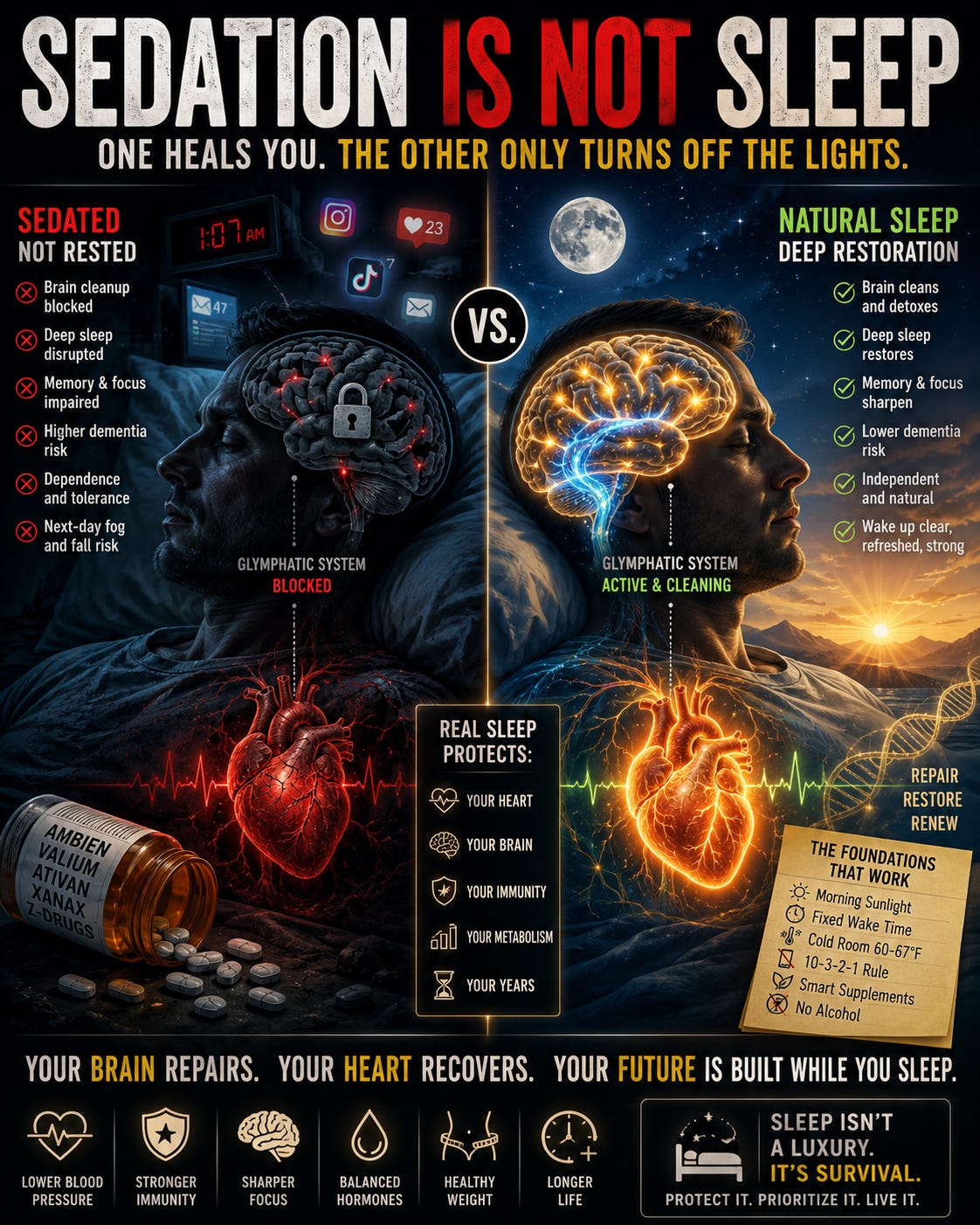
These drugs do not fix your sleep. They sedate you while your sleep stays broken. The deep and dreaming stages — where your body and brain actually repair — remain disrupted underneath. You’re knocked out. You’re not recovering.
Sedation is not sleep. It’s a costume sleep wears so you’ll stop asking questions.
5. Here’s what actually works — and most of it is free.
No prescription. No grogginess. No dependence. Most people feel the shift within days.
☀️ Morning sunlight — within the first hour of waking. 15–20 minutes. No sunglasses, no glass between you and the sky. This single habit resets your internal clock more powerfully than any pill or supplement on the planet. It costs nothing and it is the highest-leverage thing on this entire list.
⏰ A fixed wake time. Every day. Weekends included. This matters more than your bedtime. Your body anchors its rhythm to when you wake, not when you fall asleep. Sleeping in creates “social jet lag” — a self-inflicted time-zone change that wrecks you for days.
🌡️ A cold room: 60–67°F. Your core temperature has to fall for sleep to begin. A warm bedroom fights you all night long.
📵 The 10-3-2-1 rule — screenshot this one:
10 hours before bed → no caffeine
3 hours before → no food, no alcohol
2 hours before → no work, no stress
1 hour before → no screens
The supplement stack that actually moves the needle.
Most sleep supplements are marketing. These are the ones with real mechanisms behind them — the ones worth your money.
💊 Magnesium glycinate — 300–400mg, 30–60 min before bed. The single most reliable sleep supplement there is. It calms the nervous system, supports vascular tone, and deepens sleep quality. Most people are quietly deficient. This is the one people thank me for most.
💧 Glycine — 3–5 grams before bed. It gently cools your core temperature — the exact signal your body needs to drop into sleep faster and stay in deep sleep longer. Many people say it’s the first thing in years that let them sleep like they did in their twenties.
🌿 L-theanine — 200mg. Quiets the racing-mind chatter without sedating you. Pairs beautifully with magnesium for the “my brain won’t turn off” problem.
🍒 Apigenin — 50mg (the calming compound in chamomile, concentrated). A gentle nudge toward sleep onset for people who lie awake wired-but-tired.
🌙 Melatonin — 0.3–0.5mg, NOT 5–10mg. The biggest mistake in the supplement aisle. Melatonin is a timing signal, not a sedative. Tiny physiological doses tell your body it’s night. The megadoses sold everywhere overshoot, blunt your own production, and leave you groggy. Less is more — dramatically.
🚫 And the one “supplement” to subtract: alcohol. Non-negotiable if quality is the goal. It knocks you out faster, then shreds your deep sleep and suppresses dreaming. You wake unrested because you are — your brain never finished the repair cycle. A nightcap is borrowing from tomorrow at a brutal interest rate.
A note: introduce one at a time so you learn what your own body responds to, and check with your doctor if you’re on medication or pregnant.
🧠 And if insomnia has lasted more than three months: ask about CBT-I — Cognitive Behavioral Therapy for Insomnia. It beats sleeping pills in long-term outcomes, with zero side effects, and it’s the actual gold-standard treatment. Most people have never even heard its name. That silence is not an accident.
The deeper truth, beneath the tips.
Sleep is when your heart recovers. When your blood pressure resets. When your brain washes out the proteins that steal your future mind. When your immune system rebuilds its defenses. When growth hormone surges and your body quietly repairs the damage of the day.
Every hour of real sleep is a deposit into a biological account that funds your heart, your mind, your metabolism, your years.
Every hour lost is a withdrawal — compounding, with no grace period.
Of everything you could do for your body — every diet, every drug, every supplement, every workout — if I had to choose the single intervention that protects you more reliably than anything else, I would choose sleep.
It costs nothing. It’s available tonight. And it’s the foundation every other healthy thing is built on.
Start with just two things this week: morning sunlight, and a fixed wake time. That’s the entire ask. Most people feel the difference within days.
You were not built to be sedated.
You were built to heal — and healing happens in the dark, while you sleep.
Give it the hours it’s begging for.
Blessings.
Afshine Ash Emrani, M.D., F.A.C.C.
Assistant Clinical Professor, UCLA
David Geffen School of Medicine
Castle-Connolly Nationwide Top Doctor (Since 2008)
Los Angeles Magazine Super Doctor (Since 2010)
LA Style Magazine Top 100 Doctors in America (2024)
Subscribe to mynewsletter: substack.com/@afshineemrani
Explore my books: Amazon Author Profile
If this hit home, send it to the one person you know whose brain won’t shut off at night. It may be the most useful thing they read all year. 🔁
Great article. The benzodiazepine and Z-drug section is the most clinically important part of this piece!
You said sleep is when "growth hormone surges and your body quietly repairs the damage of the day."
For men I would put testosterone right next to that. The main daily T pulse is sleep-dependent, and Leproult's week of 5-hour nights dropped daytime testosterone 10 to 15 percent in healthy young men.
About a decade of aging, bought in one bad week. And most low-T workups never ask how the man actually sleeps.