

Let me tell you how most people die.
Not suddenly. Not dramatically. Slowly — while they were busy. While they counted their steps and their mitochondria quietly failed. While they scrolled for two hours a night and the inflammation climbed, silent and patient, in the walls of their arteries. While they waited for the annual physical that would look them in the eye and say you’re fine — a few months before the first real warning arrived.
I’ve spent more than two decades as a cardiologist, and I’ve watched this pattern more times than I can count. It is almost never a failure of effort. These are not lazy people. They are exhausted people, optimizing the wrong variables — pouring energy into things that don’t move the needle while the one thing that does goes unattended.
Here is what I’ve learned: you do not need another complicated routine. You do not need twelve supplements, a cold plunge, and a spreadsheet. You need one true priority for the next ninety days.
Restore your cellular energy, and lower the fire that drives nearly every disease I treat.
That’s it. That’s the whole game. And once that foundation is solid, everything else — the weight, the sleep, the mood, the labs — gets easier, because you’ve stopped treating symptoms and started fixing the root.
What follows is the exact protocol I give patients who are done dabbling and ready to compound. It is deliberately, almost aggressively simple. Because complexity is how people fail. The person who tries to change fifteen things changes nothing. The person who changes one thing, relentlessly, for ninety days, changes their trajectory.
First, Understand the Enemy
Two forces sit underneath most of the chronic disease I see: failing cellular energy and chronic inflammation. They are intertwined, and they feed each other.
Your mitochondria are the tiny engines inside every cell that turn food and oxygen into usable energy. When they run well, you have clear thinking, steady energy, and resilient tissue. When they falter — and they falter with age, poor food, bad sleep, and inactivity — everything downstream suffers. Fatigue. Brain fog. Insulin resistance. Slow recovery.
At the same time, a low-grade fire smolders. We call it “inflammaging” — chronic, subclinical inflammation that rises with age and drives heart disease, Alzheimer’s, cancer, and metabolic collapse. You can’t feel it. But I can measure it — IL-6, TNF-alpha, hs-CRP — and I watch it wreck arteries every day.
Fix the energy. Cool the fire. Do those two things, and you’ve addressed the soil that nearly every chronic disease grows in.
Here’s how.
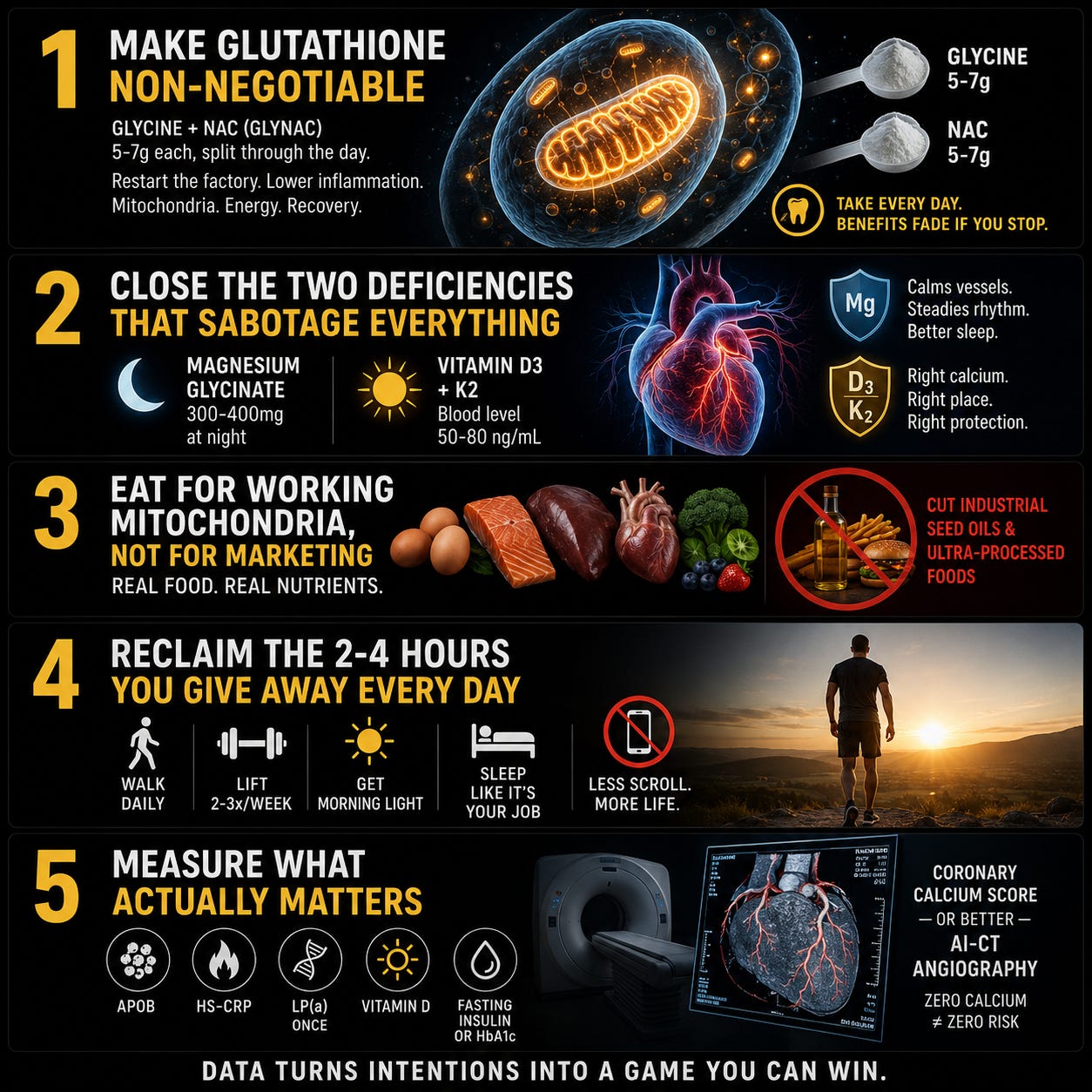
1. Make Glutathione Your Non-Negotiable
Glutathione is your body’s master antioxidant. It protects your mitochondria, recycles other antioxidants, and defends your cells from oxidative damage. And it collapses with age. Older adults are reliably glutathione-deficient — and when it drops, mitochondria slow, inflammation rises, insulin resistance worsens, and recovery dies.
Here’s the elegant part. You can restart the factory with two cheap amino acids: glycine and N-acetylcysteine — together called GlyNAC.
The reason both matter is that glutathione production has two bottlenecks, not one. Glycine runs short and cysteine runs short as you age. Give only one and you don’t fix the gap. Give both, and production restarts.
The evidence isn’t theoretical. In randomized trials at Baylor College of Medicine, older adults who took GlyNAC for 16 weeks improved nearly every hallmark of aging at once — mitochondrial function, oxidative stress, inflammation, insulin resistance, strength, cognition, and gait speed. Some markers returned toward young-adult ranges. In aged mice, the combination extended lifespan by roughly 24%.
Practical protocol for most adults over 50-60 with fatigue or rising inflammation: glycine 5-7g daily and NAC 5-7g daily, split across the day. Both are inexpensive and over the counter.
Two honest caveats. First, the benefits fade if you stop — so treat it like brushing your teeth, not a cleanse you finish. Second, talk to your physician first if you have kidney disease or take nitrates or blood thinners, and know that if you’re young and already healthy with normal glutathione, the effect will be smaller.
2. Close the Two Deficiency Gaps That Sabotage Everything Else
Two deficiencies are so common, and so quietly destructive, that correcting them should be near-universal.
Magnesium glycinate, 300-400mg at night. Magnesium calms blood vessels, supports normal heart rhythm, deepens sleep, and — critically — is required to activate vitamin D. Up to 75% of people don’t get enough. Most have no idea.
Vitamin D3 with K2, dosed to reach a blood level of 50-80 ng/mL — not the bare minimum of 30 most labs accept. Low vitamin D quietly raises cardiovascular risk and inflammation.
These two work as a system, which is why people who supplement carelessly stay stuck. Take vitamin D without enough magnesium, and you can deepen the magnesium deficiency, because your body burns magnesium to convert D into its active form. Take vitamin D without K2, and you risk directing calcium into your arteries instead of your bones — the opposite of what you want.
I take both every day. And in my experience, patients notice the difference in their sleep and their baseline sense of calm within one to two weeks — more than almost any other single change on this list.
3. Eat Like Someone Who Wants Working Mitochondria — Not Like a Marketing Campaign
You already know most of this. The problem was never knowledge. It was consistency.
Prioritize nutrient-dense real food: eggs, fatty fish, quality meat — including organ meats when you can manage them, because liver and heart are genuinely nature’s multivitamin and one of the best dietary sources of CoQ10, the molecule that powers your mitochondria and that statins deplete. Add vegetables, fruit, a little raw honey if you like.
Then cut the two things quietly keeping your inflammatory fire lit: industrial seed oils and ultra-processed food. These are the fuel of inflammaging, engineered to be overeaten.
You do not need dietary perfection. You will not achieve it, and chasing it is how people quit. You need consistency that compounds — a way of eating you can hold for years, not a diet you can hold for weeks.
4. Reclaim the 2-4 Hours You Give Away Every Single Day
Here is the uncomfortable truth. Most people who say they “have no time” for their health give away two to four hours a day to a screen without noticing.
That time is more than enough. Enough to walk. Enough to lift. Enough to wind down so you actually sleep. Enough to simply sit still long enough for your nervous system to downshift out of the low-grade fight-or-flight state that keeps cortisol elevated and inflammation smoldering.
Busyness is not progress. It is often the most convincing disguise failure ever wears. If you cannot point to one measurable improvement in your energy, your recovery, or your bloodwork this week, then the motion was mostly theater.
The foundation is not complicated: walk daily. Lift something heavy two to three times a week — muscle is the organ of longevity. Get morning light in your eyes. And sleep like it is your job, because for your brain and your heart, it is.
5. Measure What Actually Matters
Vague intentions produce vague results. Data turns your health into a game you can actually win. Get these checked — and if your doctor won’t order them, ask directly, or find one who will:
ApoB (or LDL-P) — the true count of atherogenic particles, far better than standard LDL alone
hs-CRP — the inflammation marker that predicts events even when cholesterol looks fine
Lp(a) — once in your life; it’s genetic, one in five people carry a dangerous level, and almost no one has been tested
Vitamin D
Fasting insulin or HbA1c — to catch metabolic dysfunction years before diabetes
And if you have risk factors, a coronary calcium score — or better, AI-enhanced CT angiography, because a calcium score of zero does not mean zero soft plaque, and soft plaque is what ruptures.
You cannot improve what you never measured. And the first time you watch these numbers move in the right direction, the entire project stops being a chore and becomes a game.
The 90-Day Rule
Here is the discipline that separates the people who change from the people who merely feel inspired and then return to the same day tomorrow.
Do not try to overhaul your entire life at once. That is the fantasy that guarantees failure. Instead, make cellular energy and lower inflammation the only thing that is non-negotiable for three months. One priority. Obsession-level focus. No half-measures.
Everything else rearranges around a solid center. When your energy returns and the fire cools, the better food gets easier, the movement gets easier, the sleep gets easier — because you’re no longer fighting a body running on empty.
Most people will read this, feel a genuine spark, and then let tomorrow look exactly like yesterday. That’s not a character flaw. It’s the default. The ones who actually change are the ones who treat their biology the way a serious person treats a business or a craft: with deliberate, repeated action, sustained long enough that it stops being something you do and becomes something you are.
Your future self will not care how busy you were. It will not be impressed by your packed calendar or your unanswered emails.
It will care about one thing only: whether the factory was running.
Start today. One priority. Ninety days.
Then look at the markers, and look in the mirror, and decide whether the rest of your life deserves the same.
Blessings.
Afshine Ash Emrani, M.D., F.A.C.C.
Assistant Clinical Professor, UCLA
David Geffen School of Medicine
Join Our new website
Castle-Connolly Nationwide Top Doctor (Since 2008)
Los Angeles Magazine Super Doctor (Since 2010)
LA Style Magazine Top 100 Doctors in America (2024)
Subscribe to mynewsletter: substack.com/@afshineemrani
Explore my books: Amazon Author Profile
claude said this:
NAC can potentiate nitroglycerin, raising hypotension risk
Alivelongevity
Glycine can interact with clozapine
Alivelongevity
GlyNAC may interact with blood thinners and chemotherapy drugs due to its effect on glutathione
VitalityPRO
If you have a history of kidney stones, blood pressure medication use, or an active infection/immune suppression, extra caution is warranted
Alivelongevity
It's recommended to stop GlyNAC at least 2 weeks before any surgery
VitalityPRO"
Reviewers of the NutriCost NAC+ GLYCINE Unflavored Powder say the taste is horrendous. Is that a product you have used yourself?